
Why Long Study Sessions Make Your Body Ache
You sit down to study “for a bit,” and suddenly an hour has passed and your back, neck, and shoulders hurt more than your brain does.
At some point it stops being hard to solve the problems and starts being hard to simply stay in your chair.
If you often study in the library or at a cafe, you may notice numb legs, a forward head posture, and stiff shoulders by the afternoon.
You know that “stretching would probably help,” but when you finally stand up, it is hard to know what to do first and in what order.
This article walks you through a simple 15-minute full-body stretch routine you can do almost entirely in a chair.
It is designed for long study days: you can use it at home, in the library, or anywhere you have a stable chair and a bit of space around you.
1. Upper-Body Chair Stretches (5 Minutes)
Before you jump into stretches, take one minute to settle your breathing.
Sit comfortably on your chair, place your feet flat on the floor, and inhale through your nose for a slow count of four, then exhale through your mouth for four.
Repeat this cycle five times and let your shoulders drop with each exhale.
Loosen anything tight around your waist or chest so your rib cage can move freely.
If you already have pain in a specific area, keep every movement small and gentle.
Aim for a “pleasant stretch” feeling and stop well before any sharp or electric pain.

1.1 Side Neck Stretch
- Sit toward the front of the chair without leaning on the backrest.
- Hold the side of your chair with your left hand.
- Place your right hand lightly on the left side of your head and gently pull your ear toward your right shoulder.
- Exhale as you feel the side of your neck lengthen, as if your ear is moving away from your shoulder.
Hold for 10–20 seconds, then switch sides.
Repeat one or two rounds per side.
1.2 Chin Tuck for Forward Head Posture
- Stay seated tall, eyes looking straight ahead.
- Gently draw your chin toward your throat, as if making a small double chin, while imagining the crown of your head reaching up to the ceiling.
- You should feel a subtle stretch along the back of your neck, not a big bend.
This simple movement helps counter the forward head posture that builds up during long study sessions.
Hold for 5–10 seconds, relax, and repeat 5–10 times with easy breathing.
1.3 Chest-Opening Shoulder Stretch
- Interlace your fingers behind your back or hold the back of your chair with both hands.
- Gently straighten your elbows and press your chest forward, lifting your breastbone slightly.
- Let your shoulders roll back and down as your chest opens.
Inhale as your chest widens, exhale as you let unnecessary tension in the shoulders fall away.
Spend about one minute moving in and out of this stretch, holding each repetition for 10–15 seconds.
Altogether, these upper-body stretches take about five minutes and prepare your neck and shoulders for more comfortable study time.
2. Wake Up Your Spine and Hips (5 Minutes)
Sitting for long periods loads the spine and hips in one fixed position.
This section gently twists and folds your body to “wake up” the joints and deep muscles that stiffen when you study for hours.
2.1 Seated Spine Twist
- Sit upright at the front of the chair with both feet flat.
- Place your right hand on the back of the chair and your left hand on your right thigh.
- Inhale to lengthen your spine; exhale as you slowly rotate your chest toward the right, turning your gaze toward the wall behind you.
- Draw your lower belly in gently as you twist so the movement comes from the whole spine, not just the neck.
Hold for 10–20 seconds without forcing.
Return to center and repeat on the left side; do one or two sets each way.
Keep the idea of “length first, twist second” rather than cranking your lower back, which is safer during long sitting days.
2.2 Figure-4 Hip Stretch
- Sit tall and cross your right ankle over your left knee, creating a “4” shape with your legs.
- Flex your right foot to protect the knee.
- Keeping your back straight, hinge forward from your hips, bringing your chest toward your right shin.
You should feel a deep stretch in the outer hip and glute of the crossed leg—not in the knee.
Hold for 20–30 seconds, breathing steadily, then switch sides.
This hip stretch is especially valuable for people who sit for hours, because tight hips and glutes can feed into low-back discomfort and stiffness.
If you are at home, you can also do this sitting on a low stool or at the edge of a sofa with one leg crossed in the same way.
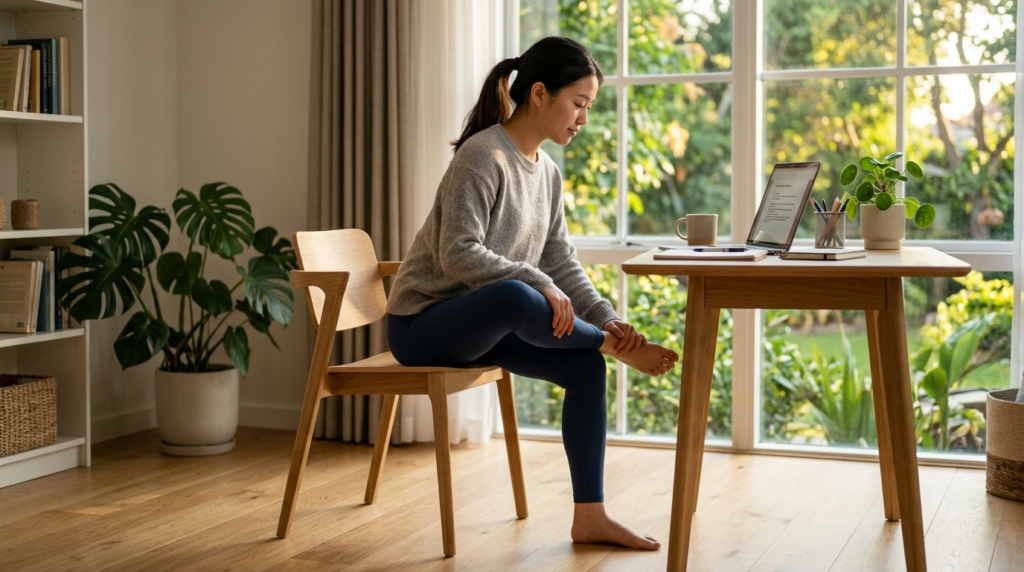
Spend about five minutes total on the spinal twist and figure-4 stretch.
By the end, your lower back and hips should feel more mobile and less heavy.
3. Leg Circulation and Full-Body Finish (5 Minutes)
The last part of the routine focuses on your legs and ankles, which often feel heavy or numb after long study blocks.
Improving circulation in this area can make it easier to sit again without feeling sluggish.
3.1 Calf and Hamstring Activation
- Sit tall and extend your right leg straight out in front of you, heel on the floor or slightly lifted.
- Point your toes away from you, then flex them back toward your shin.
- Move slowly through this range 10 times, feeling the calf and back of the leg lengthen.
Switch legs and repeat.
This simple movement helps pump blood through the lower legs and counteracts the stiffness that comes from keeping your knees bent for too long.
3.2 Ankle Circles
- While seated, lift your right foot an inch off the floor.
- Draw big, slow circles with your toes—five in one direction and five in the other.
- Try to keep the rest of your leg relaxed and focus on moving just the ankle joint.
Do the same on the other side, and repeat one more round if you have time.
As you move, you may notice warmth building around your ankles and lower legs, a sign that circulation is improving.
3.3 Standing Stretch to Reset the Whole Body
If your environment allows you to stand up for a moment, finish with a short standing stretch:
- Stand with your feet about hip-width apart, heels firmly grounded.
- Reach both arms overhead and stretch long through your fingertips.
- On each inhale, imagine you are getting slightly taller; on each exhale, let your shoulders and upper back soften downward.
- Gently sway your torso side to side a few times, like a slow, relaxed tree in the wind.
Spend about one minute here, breathing deeply.
This final step ties together the upper body, spine, hips, and legs so your whole body feels awake again.
How to Use This 15-Minute Routine in Your Study Day
When you divide the stretches into three five-minute blocks—upper body, spine and hips, legs and full-body—you get a compact routine that you can plug into your study schedule.
- Use it before you start a deep-focus session to prepare your body.
- Repeat it during a longer break between study blocks.
- On heavier days, add a second round to turn it into a 30-minute routine.
The goal is not to force extreme flexibility, but to create a sustainable habit that keeps your neck, shoulders, back, and legs from getting overwhelmed by long hours at the desk.
Over time, many people find that it becomes easier to maintain good posture and stay focused when their body is not fighting against stiffness every time they sit down.
Research on office workers suggests that a regular stretching program can reduce common musculoskeletal complaints such as neck, shoulder, and lower back pain.
https://www.ncbi.nlm.nih.gov/pmc/articles/PMC8126281
One study even found that whole-body stretching during a short lunch break helped reduce pain and fatigue over several weeks of regular practice.
Leave a Reply