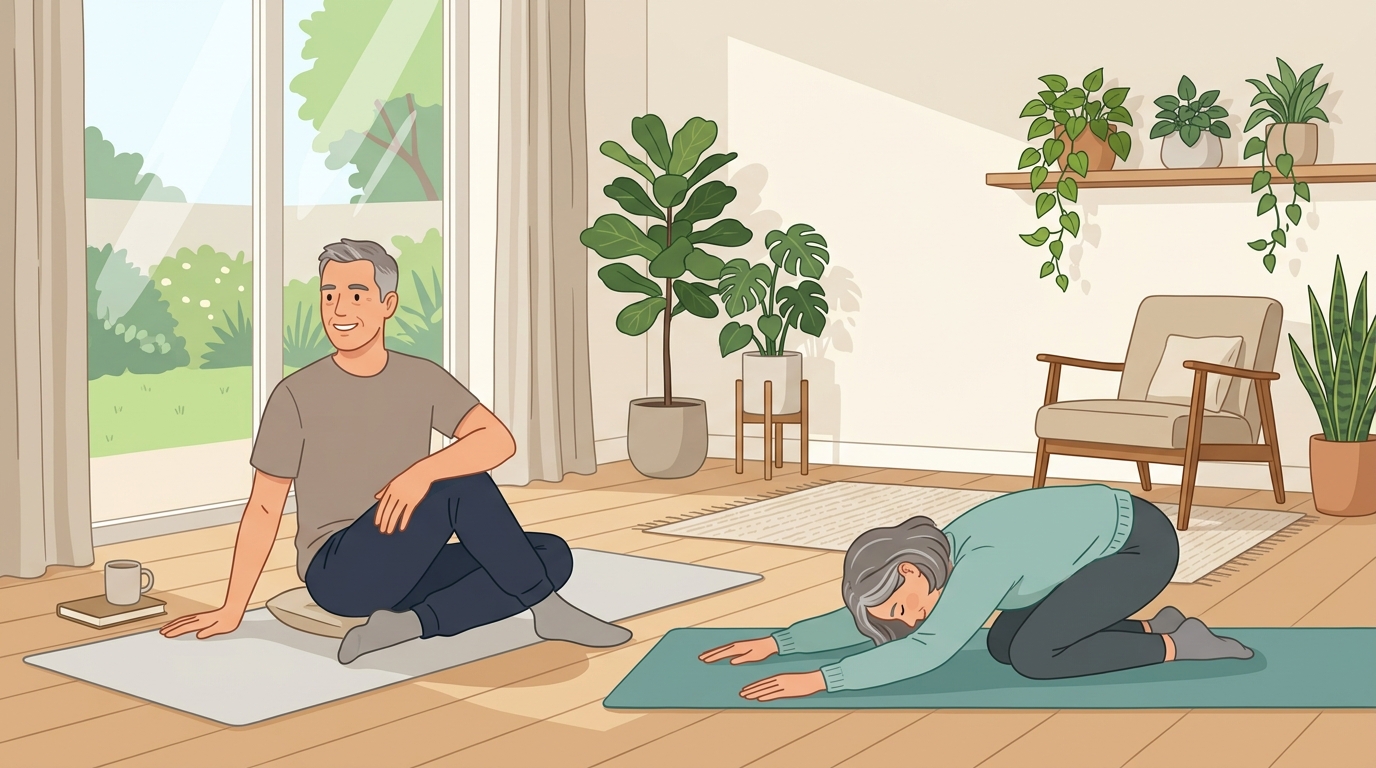
If you are in your 40s or 50s, you might feel your shoulders and lower back “say hello” every morning before you even get out of bed.
Long hours at a desk, driving, or standing can leave your neck, shoulders, and waist feeling stiff and heavy, even if you know you “should exercise more.”
This 15-minute home routine is for middle-aged adults who want gentler movement, not an intense workout.
You only need a stable chair and a bit of floor space to loosen your shoulders and lower back without going to the gym.
Flexibility and stretching programs have been shown to help reduce musculoskeletal pain and improve range of motion in older adults, especially when done regularly over weeks.
Major guidelines also recommend stretching the main muscle groups at least 2–3 days per week, holding each stretch for 30–60 seconds in older adults, which fits well with a simple 15-minute routine.
Why Your 40s and 50s Need Gentle Daily Stretching
As we age, the muscles and connective tissues around the neck, shoulders, and lower back naturally become less flexible.
What starts as mild stiffness can progress to reduced mobility and discomfort with everyday movements like bending, lifting, or turning.
When the muscles around your spine and pelvis tighten, it becomes harder to keep an upright posture.
You may notice that sitting or standing for long periods makes your lower back feel heavy, tight, or tired very quickly.
Research on stretching and low back pain suggests that regular, gentle flexibility training can improve movement, reduce stiffness, and support pain management in people with chronic or recurrent back symptoms.
Stretching is not a replacement for medical treatment, but short daily routines can slow down the process of “getting stiff” and help your body feel lighter when you start or finish your day.
15-Minute Routine at a Glance
This routine takes about 15 minutes and is designed to be simple enough to repeat most days.
This 15-minute shoulder and lower back stretch routine is built for busy people in their 40s and 50s who want a gentle, repeatable sequence at home. You can do it in the living room, beside your bed, or in a quiet corner of your home.
- Neck and shoulder release – about 5 minutes
- Lower back and hip release – about 5 minutes
- Full-body finishing stretches – about 5 minutes
You will practice around five basic movements.
Think of each movement lasting about 1 minute, repeated slowly, rather than trying to rush or count perfectly.
The goal is not to force your body to move farther.
Instead, move only to the point of gentle stretching, keep your breathing relaxed, and never push into sharp pain, numbness, or strong dizziness.
Neck and Shoulder Release (About 5 Minutes)
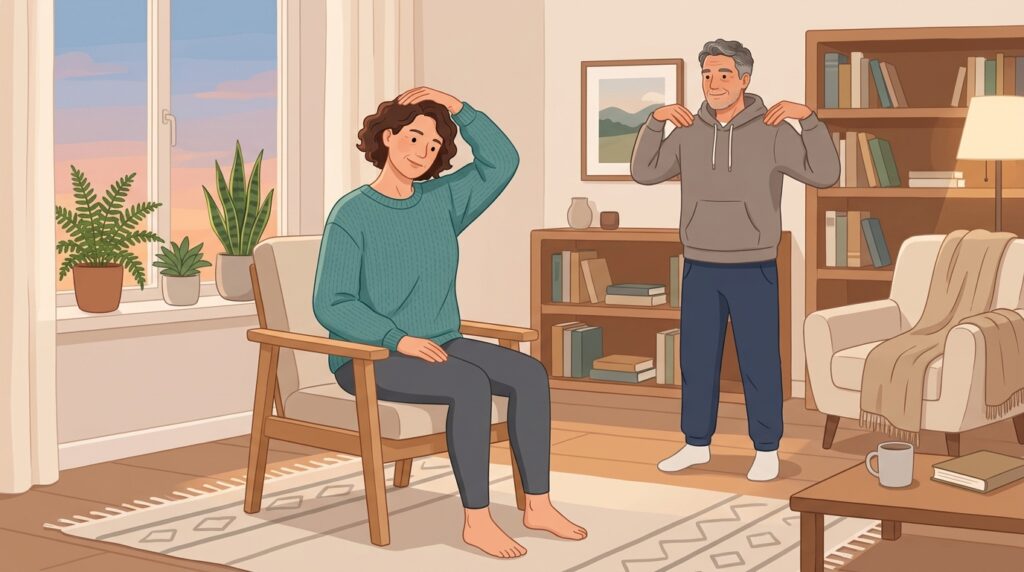
1. Side and Back of the Neck Stretch (About 2 Minutes)
- Sit on a stable chair or on the floor, with your back comfortably straight.
- Place your right hand gently on the left side of your head, just above your ear.
- Slowly tilt your head toward your right shoulder until you feel a gentle stretch along the left side of your neck.
Let your left shoulder sink down toward the floor instead of lifting up.
Breathe in through your nose and out through your mouth, holding the stretch for about 10 seconds, then slowly return to center.
Repeat 3 times on each side.
You should feel only a stretching sensation, not sharp pain or burning—do not pull or press hard with your hand.
2. Shoulder Rolls and Chest Opener (About 3 Minutes)
Step 1: Big Shoulder Rolls
- Let your arms relax by your sides.
- Slowly roll both shoulders backward in a big circle 10 times, then forward 10 times.
Match the movement with your breathing—inhaling as the shoulders rise, exhaling as they move down and back.
Imagine you are slowly erasing the stiffness that built up from hours of sitting.
Step 2: Hands Clasped Behind the Back
- Stand or sit tall and clasp your hands behind your lower back.
- Gently straighten your elbows and draw your chest forward while your shoulders move back and down.
- Keep your gaze straight ahead so your neck stays neutral, and avoid over-arching your lower back.
Hold for about 10 seconds, then relax.
Repeat this chest-opening stretch 3 times to release the front of your shoulders and chest, which often tighten in people who work at a desk or drive a lot.
Lower Back and Hip Release (About 5 Minutes)
3. Seated Forward Fold on a Chair (About 3 Minutes)
- Sit toward the front edge of a strong chair with your feet flat on the floor.
- Place your hands on your knees and lengthen your spine gently upward as you inhale.
- As you exhale, slowly fold your upper body forward over your thighs, sliding your hands down toward your ankles or shins.
Stop when you feel a comfortable stretch along your lower back and the backs of your hips or thighs.
Let your head and neck relax so they hang gently, and hold the position for 10–15 seconds while breathing calmly.
To come up, engage your abdominal muscles slightly and roll your spine back up, one segment at a time, until you return to sitting.
Repeat this movement about 5 times, only going as far as your body allows without sharp pain.
4. Lying Knee-to-Chest Stretch (About 3 Minutes)
- Place a mat or folded blanket on the floor and lie on your back with your knees bent and your feet on the floor.
- Bring both knees gently toward your chest and hold your shins or the backs of your thighs with your hands.
- As you exhale, draw your knees a little closer until you feel a gentle stretch in your lower back and around your hips.
Try to keep your lower back softly pressing into the floor instead of arching.
Hold for about 10 seconds, breathing slowly.
Release and rest your feet back on the floor, then repeat 5 times.
If it feels better, you can also pull one knee at a time toward your chest while the other foot stays on the floor.
This movement can help counter the stiffness that builds up from long sitting and is commonly used in programs for people with mild chronic low back pain.
Full-Body Stretch and Standing Side Bends (About 5 Minutes)
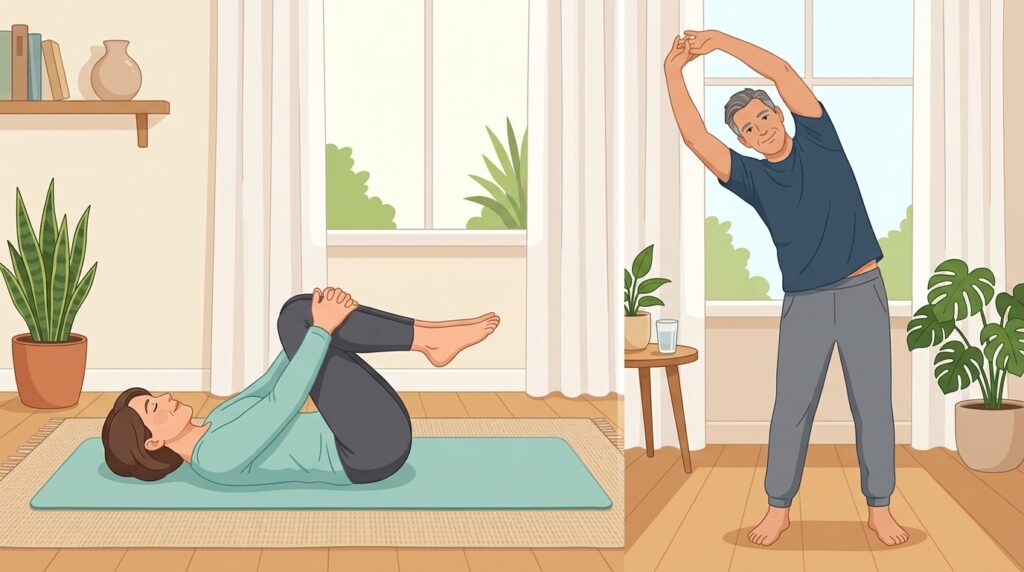
5. Overhead Reach and Side Bends (About 4 Minutes)
- Stand with your feet about shoulder-width apart.
- Interlace your fingers and reach both arms up overhead, palms facing up if comfortable.
As you inhale, grow tall through your spine.
As you exhale, slowly bend your upper body to the right, keeping your arms by your ears and your hips facing forward.
You should feel a stretch along the left side of your waist and ribs.
Hold for about 10 seconds, then return to the center and repeat on the left side.
Switch sides 3 times each.
Move slowly and avoid leaning forward or backward—imagine your body moving between two sheets of glass.
To finish, reach both arms straight up again and stretch from your fingertips down to your heels as if you are making your whole body a little longer.
Hold for 10 seconds and gently release your arms by your sides.
When and How Often to Do This Routine
For many people in their 40s and 50s, the best times for this routine are:
- Morning – to gently wake up a stiff back and shoulders before work
- Evening – to release tension from a long day at a desk or on your feet
Flexibility guidelines suggest stretching the main muscle groups at least 2–3 times per week, and older adults may benefit from holding each stretch for around 30–60 seconds in total per muscle group.
If 15 minutes every day feels like too much at first, you can choose just 3 movements and build up gradually.
You can also set a small alarm on your phone and treat this routine like brushing your teeth—a simple daily habit that protects your body over the long term.
The goal is consistency, not perfection.
Important Safety Tips for Your 40s and 50s
- Move into each stretch slowly and stop at a feeling of mild to moderate tightness, not pain.
- Do not bounce or jerk—use smooth, controlled movements.
- If you feel sharp pain, strong numbness or tingling in your arms or legs, chest tightness, severe dizziness, or difficulty breathing, stop immediately.
People with diagnosed spinal problems, significant arthritis, osteoporosis, or other musculoskeletal conditions should check with a doctor or physical therapist before starting a new routine.
Studies on older adults show that stretching is generally safe when movements are gentle and adapted to individual limits, but medical guidance is important if you already have chronic pain or other health conditions.
Related 15-Minute Routines You Might Like
If your lower back is your main trouble area during the day, this routine can work alongside today’s stretches:
15-Minute Back Stretch Routine for Desk Workers – a simple sequence to release your lower back after long hours of sitting.
If your neck and shoulders feel tight from working at a computer or using your phone, try this on alternate days:
15-Minute Neck and Shoulder Stretch Routine for Desk Workers – focused stretches to ease neck stiffness and rounded-shoulder posture.
FAQ: Stretching in Your 40s and 50s
Q1. How often should I do this 15-minute routine?
If you are new to stretching, aim for this routine 2–3 times per week at first.
As your body adjusts, you can increase to most days of the week, which matches flexibility training guidelines for adults in midlife and beyond.
Q2. Can this routine replace exercise for heart health or weight control?
Stretching helps your joints move more easily and can reduce discomfort, but it does not replace cardiovascular or strength training for heart health, metabolism, or weight management.
Think of it as one part of a healthy movement plan, together with walking, resistance training, or other activities you enjoy.
Q3. Will these stretches cure my back or shoulder pain?
Stretching alone will not “cure” all pain, but research suggests that regular flexibility training can reduce stiffness, improve function, and support pain management in people with chronic musculoskeletal discomfort.
If pain is persistent, severe, or getting worse, it is important to talk with a healthcare professional for a full assessment.
Q4. Is it too late to start stretching in my late 50s or early 60s?
It is almost never too late to start moving more gently and regularly.
Studies show that older adults can still improve flexibility and reduce pain with consistent stretching, even when they begin later in life.
Learn More from Trusted Resources
If you want to explore more about stretching and flexibility in midlife and older age, these resources are a good starting point:
Evidence-based guidelines on flexibility training for adults and older adults, including recommended frequency and stretch duration:
https://www.acsm.org (see ACSM flexibility training guidelines)
Overview of how stretching helps older adults maintain flexibility, reduce stiffness, and support mobility and independence in daily life:
https://www.racmn.com/blog/the-importance-of-stretching-for-seniors-how-flexibility-supports-health-mobility-and-independence
Leave a Reply