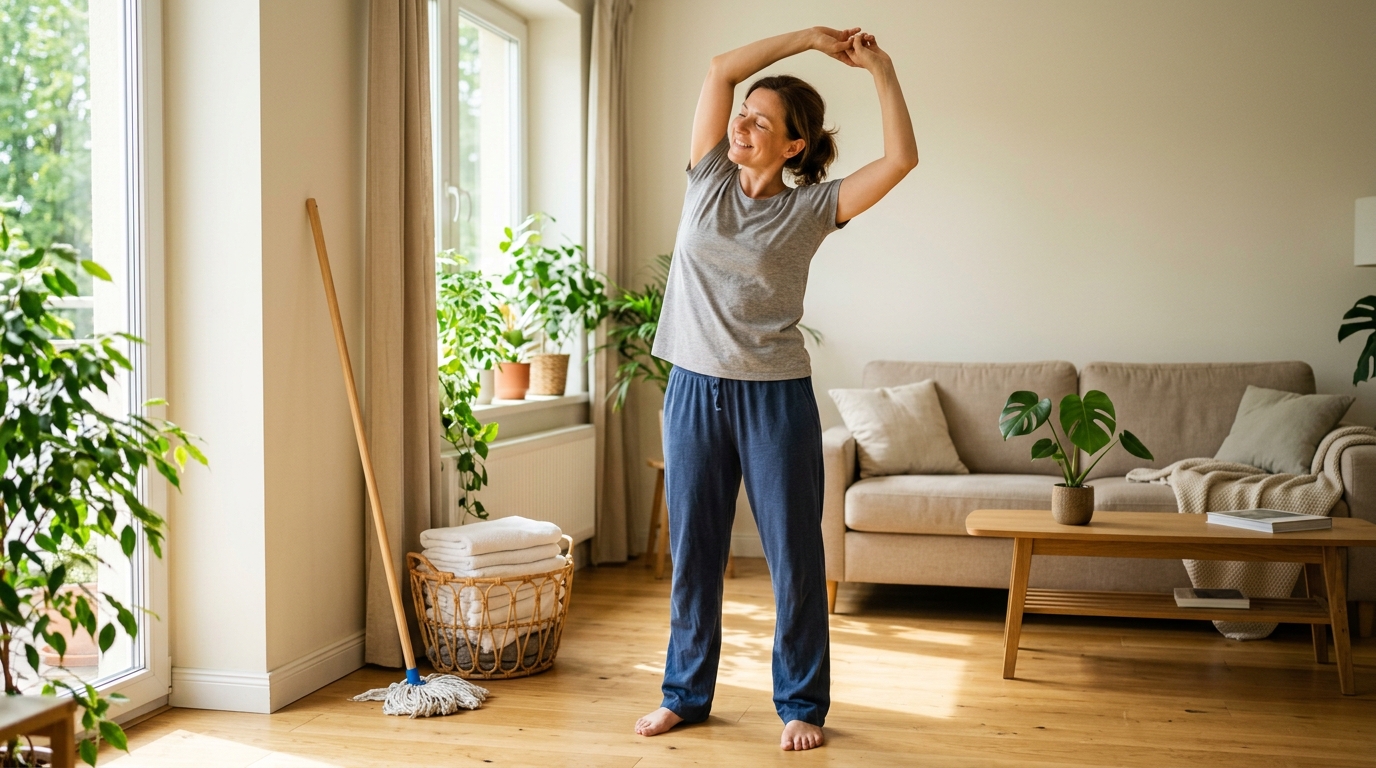
On days when you power through cleaning, laundry, and dishes in one go, your home feels refreshed but your lower back and knees can feel worn out.
Long periods of squatting, bending forward, and kneeling for floor or bathroom cleaning put repeated stress on the muscles around your spine and the joints in your knees.
Studies on domestic work and musculoskeletal pain suggest that frequent, physically demanding chores are associated with a higher risk of lower back and knee discomfort, especially when the work involves a lot of bending and awkward postures.
That is why short, regular recovery routines matter more than doing a long workout once in a while.
In this guide, you will learn a simple 15-minute stretching routine you can do after housework to gently relieve tension in your lower back and around your knees while staying within a safe, comfortable range of motion.
How This 15-Minute Recovery Routine Works
This routine is designed as a practical cool-down right after housework, not as an intense workout.
You will move through three short blocks:
- About 5 minutes for lower back and pelvis
- About 5 minutes for the muscles around your knees
- About 5 minutes for full-body finishing stretches
Each stretch is held for around 10–30 seconds and repeated a few times at a slow, relaxed pace.
The goal is not to force big ranges of motion but to help your muscles unwind and to remind your body what a more neutral, upright posture feels like again.
As you move, stay at a mild stretching sensation—no sharp, stabbing, or electric pain.
If any position causes distinct pain, stop that movement right away and skip it.
Part 1: Loosen Your Lower Back and Pelvis (About 5 Minutes)
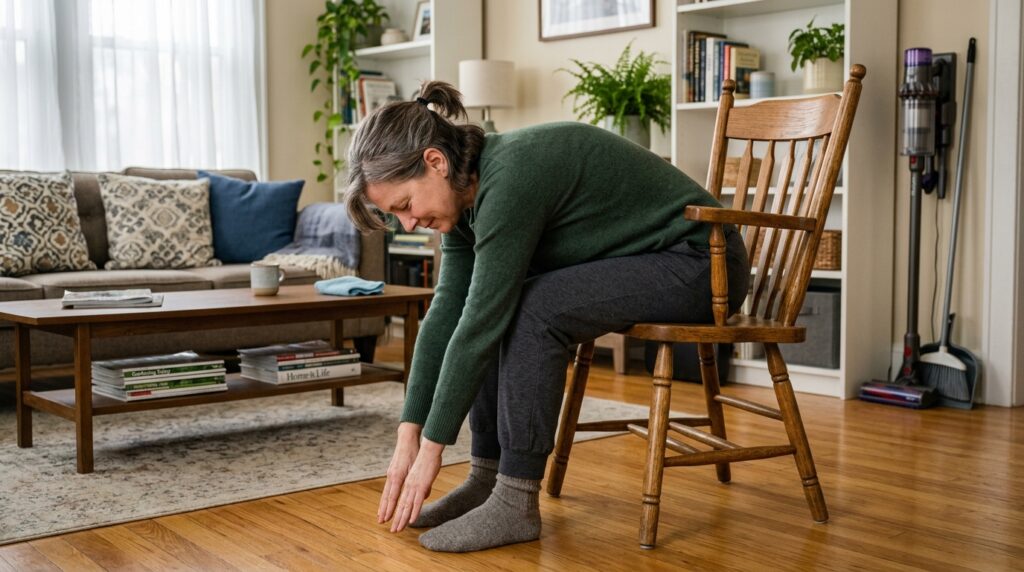
1) Seated Forward Fold on a Chair
- Sit on a sturdy chair with your feet flat on the floor, hip-width apart.
- Place your hands on your thighs and sit tall through your spine.
- Inhale gently, then exhale as you slowly roll your upper body forward, sliding your hands down toward your ankles or feet.
- Let your head and shoulders relax, and feel a gentle stretch along your lower back and the back of your hips.
- Hold for about 10 seconds, breathing slowly, then slowly roll back up to sitting.
Repeat this 3–4 times, only going as far as feels comfortable.
If you feel any sharp pain in your lower back, shorten the range and stay higher instead of reaching all the way down.
2) Lying Knees-to-Chest Stretch
This is a classic lower back stretch also recommended in many home exercise guides for back pain.
- Lie on your back on a mat, folded blanket, or bed.
- Bend both knees and place your feet flat on the surface.
- Bring both knees toward your chest and gently hold them with your hands.
- Lightly press your lower back toward the floor or mat as you breathe slowly for about 10 seconds.
- Release your feet back to the floor and rest for a moment.
Repeat about 5 times.
This kind of gentle movement can help relax tight lower back muscles and may reduce some of the strain that builds up during repeated bending and cleaning tasks.
Part 2: Ease Tension Around Your Knees (About 5 Minutes)
3) Seated Hamstring Stretch on a Chair
Tight hamstrings (the muscles at the back of your thighs) can increase the load on your knees and lower back, especially when you walk, climb stairs, or squat.
- Sit near the edge of a chair.
- Extend one leg straight in front of you, heel on the floor, toes gently pointing up.
- Keep your back long—not rounded—and hinge slightly forward from your hips.
- When you feel a mild stretch along the back of your extended thigh, hold for 10–15 seconds.
- Keep your focus on the back of the thigh, not on sharp sensations in the knee joint.
Repeat 3 times on each leg.
If you feel discomfort in the back of the knee, soften the stretch by sitting more upright or slightly bending the extended knee.
4) Standing Quad Stretch Without Kneeling
This variation lets you stretch the front of your thigh without putting direct pressure on your knees.
- Stand next to a wall, chair, or counter for balance.
- Shift your weight onto one leg.
- Bend the other knee and gently bring your heel toward your buttocks, holding your ankle or the back of your foot with your hand.
- Keep your knees close together rather than letting the bent leg swing out to the side.
- Stand tall and feel a stretch along the front of your thigh for about 10 seconds.
Repeat 2–3 times on each leg.
Since kneeling and deep squatting can increase stress on the knee joint and cartilage, a standing quad stretch is a safer alternative for many people with knee sensitivity.
Part 3: Finish with Full-Body Reset Stretches (About 5 Minutes)
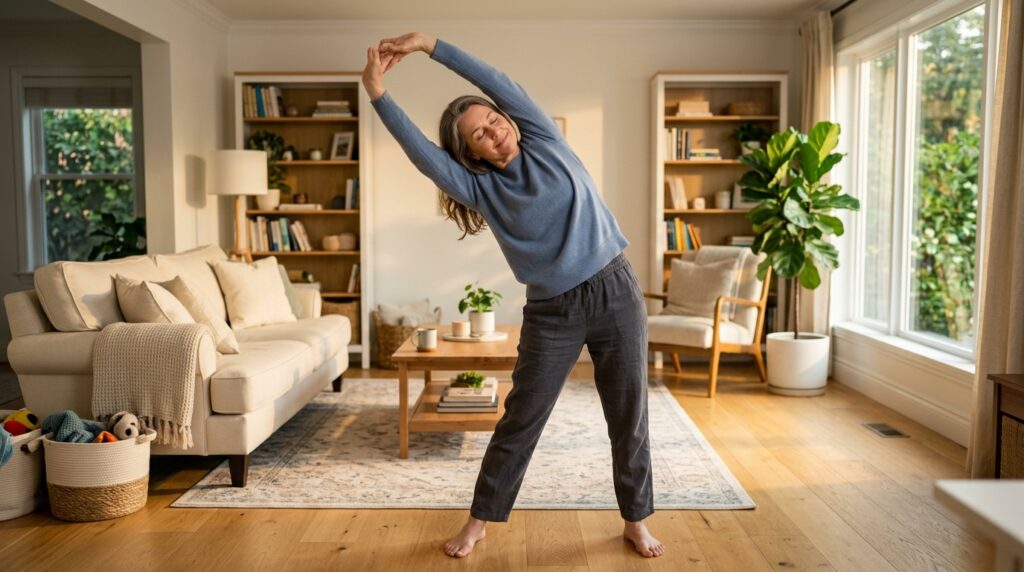
5) Standing Side Stretch for Your Waist and Back
- Stand with your feet about shoulder-width apart.
- Interlace your fingers and raise your arms overhead, turning your palms upward.
- Inhale to lengthen your spine; as you exhale, gently lean your upper body to the right, feeling a stretch along the left side of your waist and lower back.
- Hold for about 10 seconds while breathing steadily.
- Slowly return to the center, then repeat on the other side.
Go through 3 rounds on each side.
This helps open up the side of your trunk and can counteract the rounded, forward-bent positions often used during cleaning.
6) Full-Body Reach to Stand Yourself Back Up
- Stay in your standing position with feet about hip- to shoulder-width apart.
- Reach both arms straight overhead.
- Gently lift your chest and, if comfortable, raise your heels slightly off the floor so you feel your whole body lengthen from your feet to your fingertips.
- Hold for about 10 seconds, then slowly lower your heels and arms.
This final stretch acts as a reset, reminding your body of an upright posture after spending time bending over bathrooms, floors, and low surfaces.
Everyday Tips to Protect Your Back and Knees
1) Pair Each Big Chore Session with One 15-Minute Recovery Block
On days when you:
- Do a big round of cleaning
- Tackle laundry, tidying, and dishes all at once
- Spend a long time organizing or wiping low surfaces
Try to treat this 15-minute recovery routine as part of the “housework set,” not as an optional extra.
Even a short, consistent cool-down can help reduce stiffness and support long-term joint and muscle health.
2) Reduce Time Spent Squatting or Kneeling
Health information from hospitals and public health organizations often notes that long periods of deep squatting or kneeling can increase stress on the knee joint and may contribute to knee problems over time, especially in middle age and beyond.
Whenever possible, try to:
- Use tools with longer handles for floor and bathroom cleaning
- Sit on a low stool or chair instead of squatting directly on the floor
- Break long cleaning sessions into shorter blocks with brief standing or walking breaks
These small adjustments can lower the load on your knees and help protect your joint health over the long term.
Safety First: When to Stop and See a Professional
This routine is meant for light recovery and general stiffness after housework, not for diagnosing or treating serious joint or spine conditions.
If you notice any of the following while stretching, stop immediately:
- Sharp or stabbing pain in your back or knees
- Sudden swelling, warmth, or redness around a joint
- Strong dizziness, shortness of breath, or chest discomfort
If your pain persists, worsens, or interferes with daily activities, consult a healthcare professional such as an orthopedist, rehabilitation medicine specialist, or another qualified clinician before continuing.
Stay Consistent with Related 15-Minute Stretch Routines
If you often feel stiff after working at a desk as well as doing housework, you may also like my 15-Minute Back Stretch Routine for Desk Workers.
For days when exam stress drains your focus more than cleaning does, try the 15-Minute Stretch Routine to Reset Your Focus When Studying.
FAQ: Common Questions About Post-Housework Stretching
Q1. How often should I do this 15-minute recovery routine?
Ideally, every time you finish a “heavy” housework block—such as a big cleaning day or when you do several chores back-to-back—is a good time to fit it in.
Q2. Can I do these stretches even on days without housework?
Yes. You can also use this routine after a long day of standing, walking, or working in the kitchen, as long as you stay within a comfortable range and avoid pain.
Q3. What if I already have diagnosed back or knee problems?
If you have a history of disc issues, significant knee arthritis, or recent surgery, always follow your doctor’s or physical therapist’s advice first and ask them which movements are safe for your situation.
Learn More from Trusted Resources
For more general guidance on home stretching options for lower back pain, you can explore this overview of daily lower back stretches from Healthline.
https://www.healthline.com/health/lower-back-stretches
If you want a broader explanation of why gentle back exercises done regularly (sometimes in as little as 15 minutes a day) can help prevent future pain, see the Mayo Clinic’s guide to back exercises.
https://www.mayoclinic.org/healthy-lifestyle/adult-health/in-depth/back-pain/art-20546859
Leave a Reply