
When Your Pelvis and Lower Back Feel “Off”
If you sit for long hours at a desk or stand with your weight on one leg, you may notice small signals: your skirt keeps twisting to one side, one pant leg feels looser, or photos make it look like one hip is higher than the other. You might find yourself always leaning on the same leg when you stand or shifting your weight because one side of your lower back feels tight.
Over time, these small habits can make your pelvis and lower back feel “crooked” or unbalanced, even if you never received a formal diagnosis. This 15-minute home routine is designed as a gentle way to loosen tight muscles around your pelvis and spine, help your body find a more neutral position, and reduce everyday stiffness—not as a medical treatment to fix bone alignment.
I tested this routine on days when I felt uneven pressure in my hips and a dull heaviness in my lower back after sitting for hours, and a single 15-minute block made standing upright and walking feel noticeably easier.
Important Safety Note Before You Start
This routine is for mild stiffness and everyday fatigue from sitting or standing, not for diagnosing or treating serious pain or disease. If your symptoms are severe, sudden, or persistent—such as sharp pain, strong numbness, weakness, or pain that travels down your leg—stop the exercises and consult a doctor or physical therapist before continuing.
During the stretches you should feel gentle pulling or comfortable tension, not sharp, stabbing, or electric-like pain. If any movement makes your symptoms worse, reduce the range or skip that exercise.
Why Your Pelvis and Lower Back Feel Uneven
Your pelvis connects your spine to your legs and acts like a central “bridge” for weight bearing and movement. When you sit for long periods with your pelvis tucked under, cross your legs frequently, or stand with your weight mostly on one leg, certain muscles around your hips and lower back can become tight on one side and weak on the other.
This muscular imbalance can make your pelvis tilt slightly or feel rotated, which may show up as:
- A waistband or skirt that constantly shifts to one side
- One hip that looks higher in the mirror
- Feeling more pressure or stiffness on one side of your lower back or buttock
Health information from public organizations often stresses that breaking up long sitting time and doing gentle stretching can reduce strain on the lower back and help prevent musculoskeletal discomfort. Regular, light routines like this one are a practical way to care for your back and pelvis between your work or study sessions.
15-Minute Pelvis and Lower Back Reset at a Glance
This routine uses five movements:
- Pelvis and lower back release: 7 minutes
- Spine alignment and mobility: 5 minutes
- Gentle hamstring and hip release: 3 minutes
You can do all the exercises on a yoga mat, soft rug, or even a firm bed. The key principle is comfort: stay in a range where you feel a pleasant stretch or light effort, not pain.
If you often feel stiffness after desk work, you may also find it helpful to pair this routine with the 15-Minute Home Office Posture Reset: Gentle Stretches to Ease Back and Neck Tension, which focuses more on your upper back and neck.
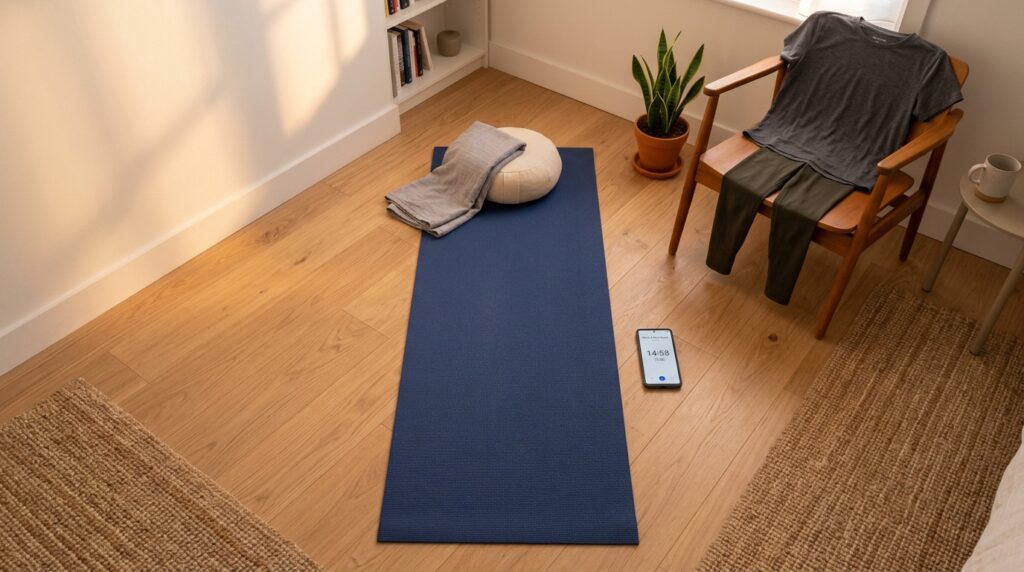
Step 1 – Pelvis and Lower Back Release (About 7 Minutes)
1. Knees-to-Chest Hug (1–2 Minutes)
- Lie on your back, looking up at the ceiling, on a mat or firm bed.
- Gently pull both knees toward your chest and wrap your arms around your shins or the backs of your thighs.
- Let your lower back sink comfortably toward the surface so there is only a small space under your spine.
- Breathe in through your nose and slowly out through your mouth, feeling your belly soften as you exhale.
If your lower back feels very tight, do not pull your knees in all the way. Stop when you feel a gentle stretch instead of strain.
2. Bridge Pose (2–3 Minutes)
- From lying on your back, place your feet flat on the floor about hip-width apart, heels roughly a hand’s length away from your hips.
- Rest your arms alongside your body.
- Inhale, then exhale as you gently lift your hips and lower back away from the floor.
- Aim for a line from your shoulders through your hips to your knees, but only rise as high as feels comfortable.
- Hold for about 5 seconds, then slowly roll your spine back down, one segment at a time, until your pelvis rests on the floor again.
Repeat 8–10 times. If your lower back hurts, reduce the height and focus on a small pelvic lift instead of a high bridge.
Bridge pose helps your pelvis and lower back muscles work together again and can offset some of the slumped position you use when sitting for long periods. On days when your lower back feels especially tired from desk work, you can combine this step with the 15-Minute Back Stretch Routine for Desk Workers once or twice a week.
3. Side-to-Side Spinal Twist (2–3 Minutes)
- Stay on your back with your knees bent and feet flat on the floor, legs together.
- Stretch your arms out to the sides in a T shape.
- Inhale, then exhale as you slowly lower both knees toward the right while turning your head to the left.
- You should feel a mild twist along the side of your waist and lower back, not a sharp pinch. Hold for 20–30 seconds.
- Return to the center, then repeat to the other side.
Alternate left and right for 2–3 rounds. If you feel sharp, shooting, or electric-like pain in your back or legs, reduce the twisting angle and move only within a comfortable range.
Step 2 – Spine Alignment and Mobility (About 5 Minutes)
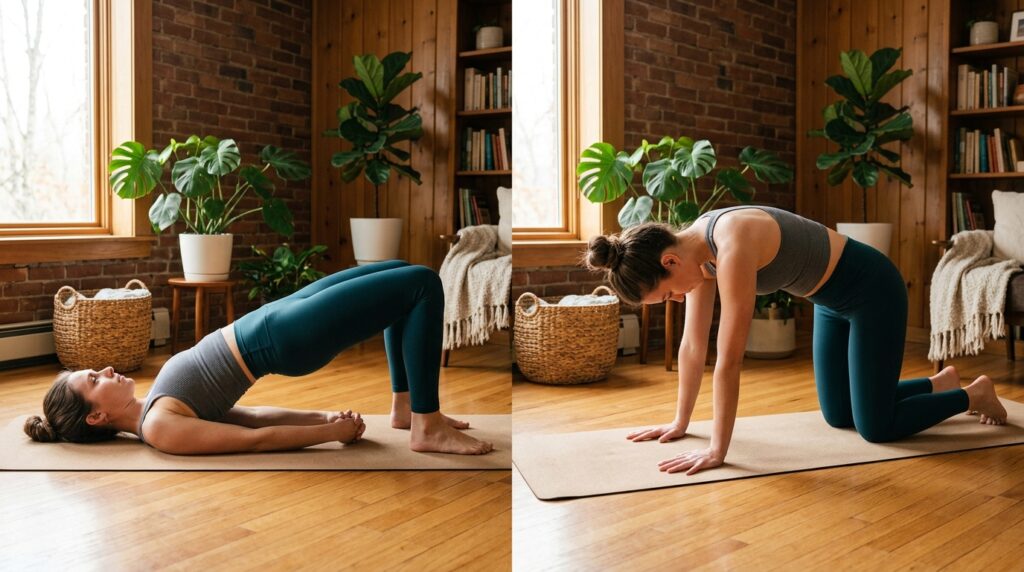
4. Cat–Cow (Cat–Cow Pose, 4–5 Minutes)
- Come onto your hands and knees on the mat. Place your hands under your shoulders and your knees under your hips.
- Spread your fingers and press your palms gently into the floor. Keep your neck long, looking toward the floor between your hands.
Then move with your breath:
- Cow pose (inhale): Let your belly drop slightly toward the floor, gently lift your chest forward, and look a bit ahead of you without compressing your neck.
- Cat pose (exhale): Draw your belly in and round your back toward the ceiling, tucking your chin slightly as you look toward your navel.
Alternate between cow on the inhale and cat on the exhale for 8–10 slow rounds. Focus on moving your spine smoothly from your pelvis through your mid-back, rather than forcing a big range in your neck.
Simple spinal mobility exercises like cat–cow are often recommended in back-care resources as part of programs to maintain flexibility and reduce stiffness in the lower back and pelvis. Even a few slow repetitions can help your body reset after a day of sitting.
Step 3 – Hamstring and Hip Release for Pelvic Balance (About 3 Minutes)
5. Lying Hamstring Stretch (3 Minutes)
- Lie on your back again.
- Bend your right knee and place your foot flat on the floor.
- Lift your left leg and hold the back of your thigh with both hands, just above the knee.
- Gently straighten your left knee as much as is comfortable, aiming your heel toward the ceiling. It is fine if your knee stays slightly bent.
- Pull your toes lightly toward your face so you feel a gentle stretch along the back of your thigh and calf. Hold for 20–30 seconds.
- Repeat on the other side.
Alternate legs for 2–3 rounds per side. If the back of your leg feels too tight, keep the knee more bent and reduce the pull. The goal is to ease tension, not to force flexibility.
Releasing the muscles at the back of your thighs can reduce the strain they place on your pelvis and lower back, especially if you sit with your legs tucked under your chair or stand with your knees locked.
What This Routine Can and Cannot Do
These five exercises focus on gently moving and relaxing the muscles and joints around your pelvis and spine. With regular practice, you may notice:
- Less stiffness when you stand up after sitting for a long time
- A more even feeling in your hips when you stand or walk
- Easier, more comfortable upright posture
However, it is important to be clear:
- This routine does not “snap your pelvis back into place” or replace medical treatment for structural problems.
- It is a light, at-home management routine to support better alignment by addressing muscle tightness and everyday posture habits.
If your pelvis or lower back still feels very uneven, or your pain is getting worse, it is safer to pause this routine and seek assessment from an orthopedic or rehabilitation specialist.
Everyday Tips to Support Your Pelvis and Lower Back
You can integrate parts of this routine into your day without always doing the full 15 minutes.
- After lunch – 5-minute reset:
Do Steps 1–3 (knees-to-chest hug, bridge pose, and side-to-side twist) to reduce afternoon heaviness in your lower back and hips. - Before bed – gentle wind-down:
Focus on the twist, cat–cow, and hamstring stretch with slower breathing to release tension before sleep. - While sitting – basic posture awareness:
Try to sit with your pelvis gently upright rather than tucked under, and place both feet flat on the floor instead of crossing your legs or tucking one foot under you.
Many public health resources recommend standing up and changing position every 30–60 minutes instead of staying in the same posture for hours. Even brief posture breaks and short stretches can help protect your lower back and pelvis over time.
If you spend most of your day at a desk, you may also benefit from the 15-Minute Neck, Shoulder, and Lower Back Stretch Routine for Keyboard and Mouse Users, which focuses on the areas that work hardest when you use a computer all day.
Related Routines You Might Like
- 15-Minute Home Office Posture Reset: Gentle Stretches to Ease Back and Neck Tension – A full routine to reset your posture after long hours of computer work.
- 15-Minute Back Stretch Routine for Desk Workers – A focused lower-back sequence for people who sit most of the day.
- 15-Minute Shoulder and Lower Back Stretch Routine for Stiffness in Your 40s and 50s – A routine tailored to common stiffness patterns that appear with age.
Frequently Asked Questions
Q1. How often should I do this pelvis and lower back reset routine?
For everyday stiffness, aim for 3–5 times per week. On days when your lower back feels especially tight after sitting, even doing just Steps 1–3 for 5–10 minutes can help. The key is consistency over time rather than doing a perfect 15 minutes every day.
Q2. What if my pelvis feels really uneven or I have sharp pain?
If you notice clear asymmetry, such as one hip looking much higher, or if you have sharp, burning, or electric-like pain that goes into your leg, stop the exercises and talk with a healthcare professional. In those cases, you may need individualized assessment and a specific exercise plan rather than a general routine.
Q3. Can I do this routine if I already have a disc problem or scoliosis?
It depends on your situation. Some people with disc issues or scoliosis can safely do gentle versions of these stretches, but others may need modifications or different exercises. If you have been diagnosed with a spine condition, ask your doctor or physical therapist which movements are safe for you before using this routine.
Q4. Do I need any special tools or posture devices for this routine to work?
No. You only need a mat, soft rug, or firm bed. Posture cushions and chairs can help you maintain better sitting positions during the day, but they do not replace regular movement and stretching. Think of this routine as a daily or weekly “reset” that supports whatever sitting setup you already have.
Learn More
For more on posture, sitting, and musculoskeletal health, see:
- Mayo Clinic – Back Pain: Self-Care
Outlines safe self-care steps for mild back pain, including gentle stretching and posture changes, and explains when to seek medical care.
https://www.mayoclinic.org/diseases-conditions/back-pain/in-depth/back-pain/art-20043992 - Mayo Clinic – Office Ergonomics: Your How-To Guide
Offers practical tips on setting up your chair, desk, and monitor to reduce strain on your neck, shoulders, and lower back during long workdays.
https://www.mayoclinic.org/healthy-lifestyle/adult-health/in-depth/office-ergonomics/art-20046169 - CCOHS – Working in a Sitting Position: Good Body Position
Provides detailed recommendations for healthy sitting posture, including ideal joint angles and the importance of changing position regularly to help prevent musculoskeletal discomfort.
https://www.ccohs.ca/oshanswers/ergonomics/sitting/sitting_position.html
Leave a Reply