
Why Long Drives Make Your Back and Hips So Stiff
If every long drive ends the same way—stepping out of the car with a tight lower back and a crooked-feeling pelvis—you are not alone. Hours of sitting in the driver’s seat can leave your hips locked, your lower back stiff, and your body feeling older than it really is.
Health guidelines increasingly warn that prolonged sitting tightens your hip flexors and hamstrings and can contribute to lower back pain and joint stiffness, even in people who are otherwise fairly active.
This 15-minute routine is designed for everyday stiffness and fatigue after driving, not for treating serious pain or disease. If your symptoms are severe, new, or persistent, talk with a healthcare professional before continuing.
On days when my own back felt heavy and stiff after hours of writing and driving, testing this simple 15-minute block made the rest of the evening feel noticeably lighter and easier to move through.
Who This Routine Is For
This post-driving reset routine is especially helpful if you:
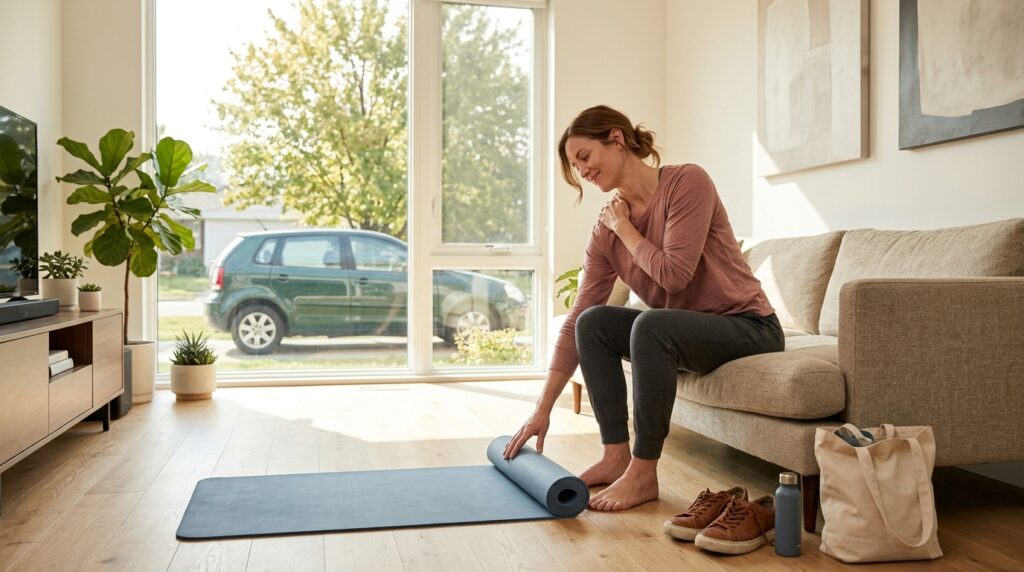
- Spend long hours behind the wheel for work (commuters, sales, delivery, ride-share or taxi drivers).
- Take frequent highway trips to visit family, friends, or clients.
- Already sit a lot at a desk and then add long drives on top of that.
Research suggests that prolonged sitting—both at work and during leisure—can increase the risk of chronic low back issues, especially when overall physical activity is low. Adding short, regular movement breaks and simple stretches can help reduce stiffness and keep you more comfortable over time.
Common Symptoms After Long Drives
If long drives pile up, you may notice:
- A heavy, dull ache in the lower back after stepping out of the car.
- A sense that your pelvis is tilted to one side, with tightness in the glutes and the back of the thighs.
- Stiffness when you stand up, as if your back does not want to straighten fully after sitting.
Many people dismiss these as “just tiredness,” but over months and years, repeated stiffness and poor posture can gradually affect your spinal alignment and comfort in daily life.
If you sit a lot to work or study, you might also benefit from a dedicated routine like our 15-Minute Back Stretch Routine for Desk Workers, which focuses on everyday office-related tension (internal link 자리).
Why a 15-Minute Post-Driving Reset Works
When you sit in one position for a long time, your hip flexors stay shortened, your glutes switch off, and your lower back muscles often take more load than they should. Over time, that combination can lead to tightness, reduced mobility, and discomfort after even moderate drives.
The goal of this 15-minute routine is to:
- Gently lengthen the muscles around the hips and lower back.
- Wake up the glutes and posterior chain so the lower back is less overloaded.
- Help your spine move again in flexion, extension, and rotation after being “stuck” in one position.
Instead of forcing yourself into one big workout once a week, doing a short, realistic reset after each long drive is often more sustainable and more effective in the long run.
Overview of the 15-Minute Post-Driving Routine
This routine takes about 15 minutes and is built around five simple moves. You can do them on a yoga mat, on a carpeted floor, or even on a firm bed if getting down to the floor is difficult.
- Pelvis & lower back release: about 7 minutes
- Spinal alignment & mobility: about 5 minutes
- Gentle finishing relaxation: about 3 minutes
Sequence:
- Knee-to-chest hold
- Bridge pose
- Supine spinal twist
- Cat–Cow
- Legs-up relaxation
If you are also dealing with everyday lower back and pelvic tension from home life or standing all day, you might like our 15-Minute Pelvis and Lower Back Reset Routine at Home as a complementary option (internal link 자리).
Step-by-Step 15-Minute Post-Driving Reset Routine
1. Single Knee-to-Chest Hold (Pelvis & Lower Back Release)
Starting position
Lie on your back on a mat, carpet, or firm bed, with both legs extended comfortably.
How to do it
- Slowly bring one knee toward your chest.
- Use both hands to gently hold your shin or the back of your thigh.
- Lightly press your lower back toward the floor or mattress as you hold for 10–15 seconds.
- Switch sides and repeat.
- Alternate left and right for 2 sets each.
Breathing
Inhale through your nose, then exhale slowly and imagine your hips and lower back softening into the surface beneath you.
Safety tips
- If your lower back feels tender, do not pull the knee too close—find a mild stretch and stay there.
- If grabbing your shin is uncomfortable, hold behind the thigh instead.
This simple move helps gently open the hip and relieve some of the tension built up from keeping your hip flexed in the car seat for a long time.
2. Bridge Pose (Glute and Back Activation)
Starting position
Lie on your back with your knees bent and feet flat on the floor, hip-width apart. Place your arms by your sides.
How to do it
- Inhale and gently squeeze your glutes.
- Slowly lift your hips off the floor so that your shoulders, hips, and knees form a rough straight line.
- Hold for about 3 seconds at the top.
- Exhale as you slowly lower your hips back down.
- Repeat about 10 times, moving with control.
Breathing
Inhale as you lift, exhale slowly as you lower.
Safety tips
- Focus on using your glutes and the back of your thighs, not just your lower back.
- If you feel pinching in your lower back, reduce the height of the bridge and move more gently.
By reactivating the glutes after long periods of sitting, you help shift some of the load away from the lower back, which can reduce stiffness and improve support for your spine.
3. Supine Spinal Twist (Release Twisting and Side Tightness)
Starting position
Lie on your back with your knees bent and feet flat on the floor. Stretch your arms out to the sides at shoulder height to form a “T” or “L” shape.
How to do it
- Bring your knees together so they are touching.
- Exhale as you slowly lower both knees to one side, keeping your shoulders relaxed on the floor.
- Turn your head to the opposite side of your knees.
- You should feel a gentle stretch along your lower back, side body, and possibly the outer hip.
- Hold for 10–15 seconds, breathing smoothly.
- Return to the center and repeat on the other side.
- Perform 2 sets on each side.
Breathing
Breathe naturally and imagine your muscles softening a little more with each exhale.
Safety tips
- Your knees do not have to touch the floor—stop where the stretch feels comfortable and pain-free.
- Avoid forcing the movement if you feel sharp pain or strong discomfort.
This twisting movement helps counteract the one-sided posture and micro-twists many drivers hold unconsciously while steering or resting one leg differently on the pedals.
4. Cat–Cow (Full Spine Realignment and Mobility)
Starting position
Come onto all fours with your hands under your shoulders and your knees under your hips. Spread your fingers and press gently into the floor.
How to do it
- Inhale as you let your belly drop slightly toward the floor, lifting your chest and sitting bones while keeping your neck long (Cow pose).
- Exhale as you round your spine toward the ceiling, drawing your navel gently in and letting your head follow the curve (Cat pose).
- Move slowly between these two positions 8–10 times, staying within a comfortable range.
Breathing
Match your breath to the movement: inhale in Cow, exhale in Cat, and focus on steady, smooth breaths.
Safety tips
- Keep your gaze between your navel and the space just in front of your hands to avoid straining your neck.
- Move gently; the goal is to explore motion, not to push into pain.
Cat–Cow helps restore movement through the entire spine after it has been fixed in one shape during a long drive, which can ease stiffness and reduce the sense of being “stuck.”
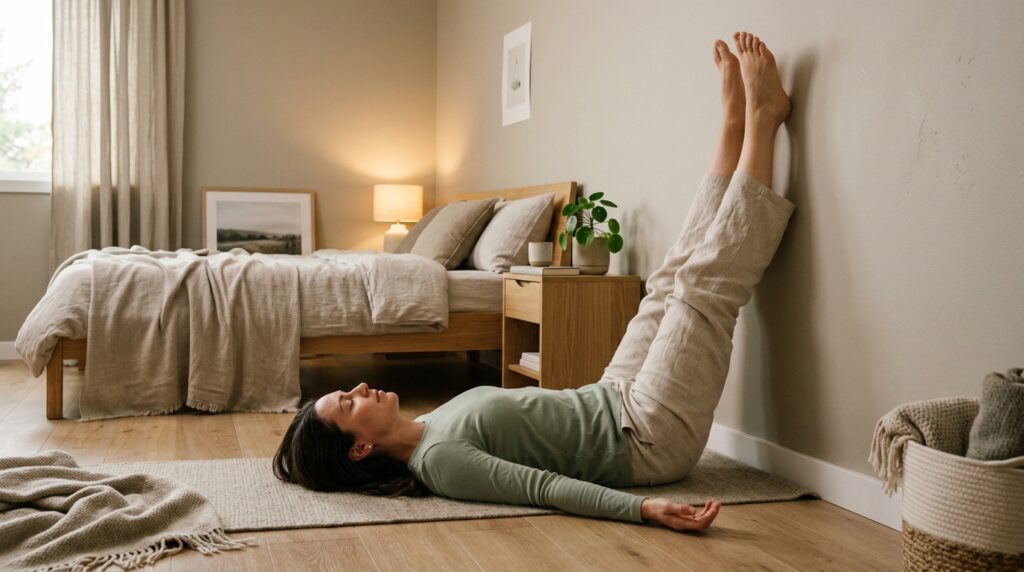
5. Legs-Up Relaxation (Finishing Decompression)
Starting position
- Lie on your back in a comfortable position.
- Place your calves on a chair or rest your legs up against a wall, with your knees slightly bent.
How to do it
- Adjust your position so your lower back feels supported and relaxed.
- Stay here for about 3 minutes, letting your body settle.
Breathing
- Breathe slowly into your belly, feeling it rise and fall.
- If it helps, count 4 seconds as you inhale and 6 seconds as you exhale.
What it helps with
- Gently shifts some load away from the lower back and pelvis, which can feel refreshing after standing up from a long drive.
- Promotes relaxation so you finish the routine calmer and more grounded.
If you regularly use other recovery tools like a foam roller, you may also benefit from our 15-Minute Foam Roller Routine: Full-Body Release with Heat Packs and Herbal Tea, which pairs well with this legs-up position on particularly tiring days (internal link 자리).
How to Build a Post-Driving Habit That Actually Sticks
Even the best routine will not help if you only do it once. The real benefit comes from using this reset consistently whenever long drives are part of your day.
Here are a few practical tips:
- Do it before you shower or sit down at home. Make your sequence “park the car → 15-minute reset → shower or dinner.”
- Use rest stops wisely. On very long drives, try to stop every 60–90 minutes to walk a bit and do 1–2 quick stretches.
- Adjust your driving posture. Keep your pelvis neutral, avoid slumping, and place both feet evenly on the floor when possible so you are not leaning to one side.
Health organizations and pain-management services often stress the value of regular movement breaks, pacing your activities, and using simple stretches instead of complete rest when you are dealing with everyday back pain. A short, gentle routine like this fits well with that approach.
Important Safety Notes
This routine is designed for mild stiffness and fatigue after driving, not for treating serious pain, injury, or disease. If your back pain is intense, radiates down your leg, comes with numbness or weakness, or is new and unexplained, seek medical advice before trying or continuing these exercises.
If you already see a physiotherapist, chiropractor, or other clinician for back or hip issues, ask them which of these moves are appropriate for you and which you should avoid or modify.
Related Routines You Might Like
If long drives are only part of the problem, and you also spend a lot of time at a desk or standing, these other 15-minute routines can fit alongside your post-driving reset:
- 15-Minute Back Stretch Routine for Desk Workers – A simple, office-friendly sequence to ease daily lower back and upper back tension from long hours at the computer.
- 15-Minute Stretch Routine to Release Your Back and Hips After a Long Drive – A closely related routine you can alternate with this one for variety and slightly different movement patterns.
- 15-Minute Pelvis and Lower Back Reset Routine at Home: Gentle Stretches for Everyday Stiffness – Ideal for days when your hips and pelvis feel tight even without a long drive.
You can rotate these routines throughout the week based on what kind of day you had—heavy driving days, desk-heavy days, or busy housework days.
Frequently Asked Questions
Q1. Can I do this routine even if I am a complete beginner?
A: Yes. All of the movements in this routine are low-impact and beginner-friendly, with room to adjust the range of motion based on your comfort level. Focus on moving slowly, matching your breath to the movement, and avoiding any positions that cause sharp pain.
Q2. What if I do not always have 15 minutes after driving?
A: If 15 minutes feels impossible, start with 5 minutes and choose just two moves—for example, the knee-to-chest hold and Cat–Cow. The important part is building a consistent “after driving, I move a little” habit; you can always extend it later when your schedule allows.
Q3. How often should I do this post-driving reset?
A: Aim to do this routine after any drive that leaves your back or hips feeling stiff, especially if you have been on the road for more than an hour or two. On very busy weeks, try for at least 3 sessions, even if some of them are shorter.
Q4. Is it okay to do this if I already have chronic back pain?
A: Many people with mild, stable chronic back pain benefit from gentle movement and stretching, but it is important to get individualized advice. If you have been diagnosed with conditions like a disc problem, spinal stenosis, or severe scoliosis, consult your healthcare provider or physiotherapist to confirm which of these moves are safe for you and which should be modified or skipped.
Learn More
If you’d like to understand the bigger picture behind why this 15-minute post-driving routine matters, these evidence-based resources on sitting, driving, and back health are a great next step:
- Harvard Health Publishing – “The dangers of sitting”
Explains how prolonged sitting tightens hip flexors and hamstrings and how that can contribute to lower back and knee discomfort, along with practical tips to move more during the day.
https://www.health.harvard.edu/pain/the-dangers-of-sitting - Royal Orthopaedic Hospital (NHS) – Back pain keeping you from moving?
Offers practical advice on pacing activities, using regular movement breaks and stretches, and staying gently active instead of complete rest when managing everyday back pain.
https://roh.nhs.uk/news-events/back-pain-keeping-you-from-moving - Manor View Practice – Driving and Back Pain
A concise guide with posture tips, seat adjustment advice, and simple exercises to reduce back pain related to driving and long car journeys.
https://manorviewpractice.co.uk/clinical-services/first-contact-physiotherapy/driving-and-back-pain/
Leave a Reply