Why Your Neck and Shoulders Feel Tight After a Day at the Screen
If you spend most of your day at a desk or on your phone, you’ve probably caught yourself in this position:
head poking forward, shoulders rounding in, and upper back slowly turning into a C-shape.
Remote work, long study sessions, or evenings on the couch can all pull your head forward and round your shoulders over time.
When this posture sticks, your neck and shoulder muscles work overtime just to hold your head up.
That’s when symptoms like these start to appear:
- A constant, dull ache at the back of your neck
- Tightness and knots on top of your shoulders
- A chest that feels “closed in” while your upper back curves more and more
Forward head posture and rounded shoulders are common in people who spend long hours at a computer or looking down at devices.
Health sources consistently point out that stretching the neck, chest, and upper back and practicing good posture can help reduce pain and fatigue over time.
This 15-minute upper body posture reset is a gentle routine to ease stiffness and remind your body what upright feels like again.
It’s for mild daily stiffness and fatigue, not for serious injuries.
This routine is for mild stiffness and fatigue, not for treating serious pain or disease.
If your symptoms are severe, new, spreading into your arms, or persistent, consult a healthcare professional before continuing.
On days when my own neck and shoulders felt tight after hours of laptop work, even one 15-minute block like this made my head feel lighter and my posture less slumped for the rest of the evening.
Overview: Your 15-Minute Upper Body Posture Reset
You don’t need special equipment for this routine—just some floor space and a chair.
Total time: 15 minutes
- 6 minutes – Neck and Shoulder Release
- 6 minutes – Chest and Upper Back Stretching
- 3 minutes – Relaxation and Breathing
You can do this:
- After work or class, before you lie on the couch
- During a break on heavy computer days
- In the evening before bed to unwind your upper body
For days when your lower back and hips feel tight too, you may want to pair this with your existing
15-Minute Home Office Posture Reset: Gentle Stretches to Ease Back and Neck Tension.
Step 1 – Neck and Shoulder Release (6 Minutes)

These moves help your neck and upper shoulders let go of some of the tension from hunching and craning forward.
1. Seated Side Neck Stretch (Lateral Flexion)
- Sit tall in a chair with your feet flat on the floor.
- Hold the edge of the chair with your right hand.
- Place your left hand gently on the right side of your head.
- As you exhale, slowly tilt your head toward your left shoulder until you feel a gentle stretch along the right side of your neck.
- Hold for 15–20 seconds, then switch sides.
Repeat 2 sets per side.
Breathing tip
Inhale to think of your spine lengthening.
Exhale and imagine the side of your neck melting a little more each time.
Important
Do not yank your head with your hand.
Use your hand only to gently guide the stretch—stop at “comfortably tight,” not pain.
2. Shoulder Rolls and Shrug–Drop
- Sit tall with your arms relaxed by your sides.
- Slowly lift your shoulders up toward your ears.
- Roll them back and down in a big, smooth circle.
- Repeat 10 times.
- Then reverse the direction, rolling forward 10 times.
Next:
- Lift both shoulders up toward your ears again.
- As you exhale, let them drop down with a soft “sigh” or relaxed exhale.
- Repeat 5–10 times.
Breathing tip
Inhale as your shoulders rise, exhale as they roll and drop.
Imagine stress sliding off your shoulders as you breathe out.
Important
Move slowly and smoothly.
Fast, jerky movements can irritate your joints.
Step 2 – Chest and Upper Back Stretching (6 Minutes)
Forward head posture and rounded shoulders are often linked to tight chest muscles and a stiff upper back, combined with weaker upper back muscles.
These stretches help open the front of your body and mobilize your spine.
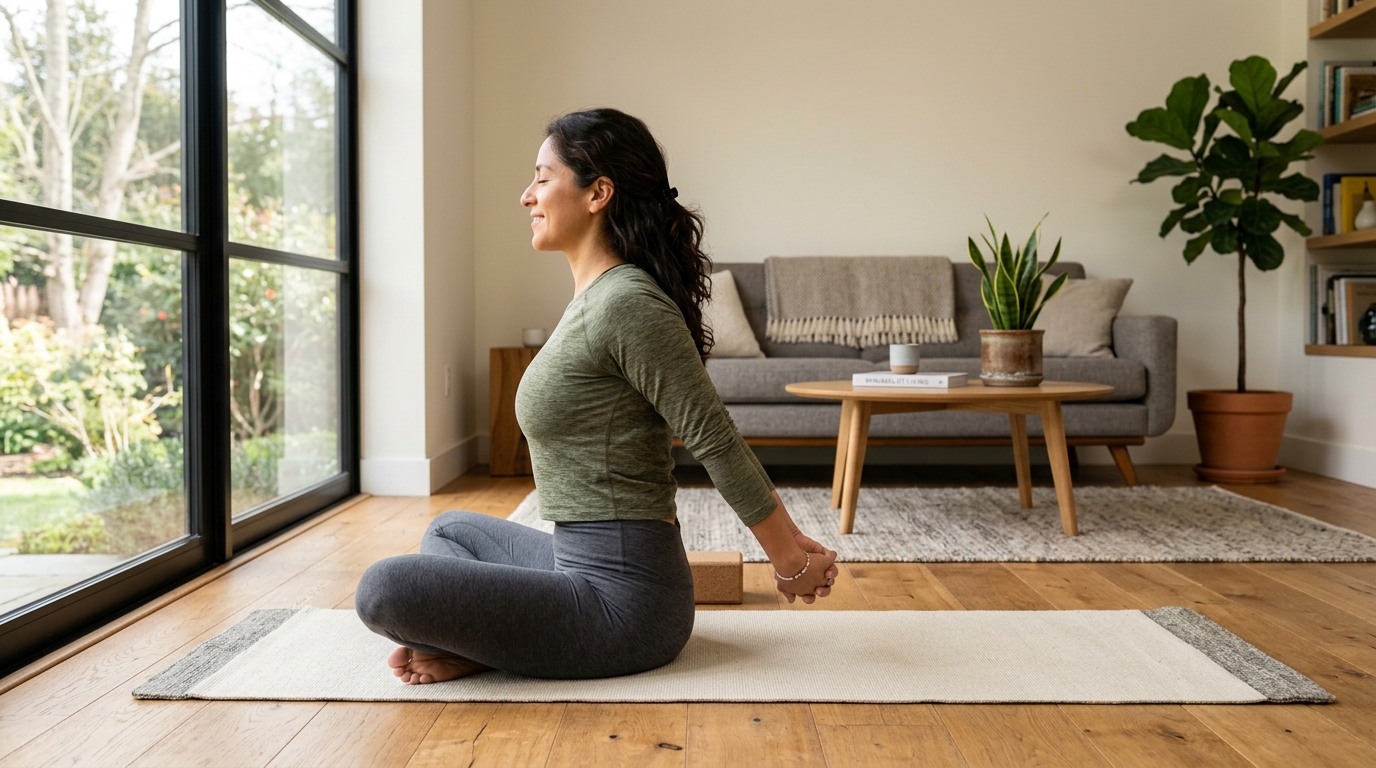
3. Chest-Opening Stretch (Standing or Seated)
You can do this standing or sitting.
- Interlace your fingers behind your back.
- Straighten your arms as much as is comfortable.
- Gently lift your hands slightly away from your back while you open your chest forward.
- Keep your shoulders relaxed and away from your ears.
- Hold for 15–20 seconds, then relax.
Repeat 3 times.
This is similar to the kind of chest stretch many posture guides recommend to counteract rounded shoulders.
Breathing tip
Inhale and imagine your chest expanding forward and sideways.
Exhale and feel your shoulders dropping down and back.
Important
Avoid over-arching your lower back.
Focus on opening your chest, not bending deeply through your waist.
4. Cat–Cow (On Hands and Knees)
- Come onto your hands and knees with hands under shoulders and knees under hips.
- As you inhale, gently drop your belly toward the floor and open your chest forward, lifting your head slightly (Cow).
- As you exhale, round your back toward the ceiling, drawing your belly in and letting your head relax down (Cat).
Move slowly between these two positions for 10–12 cycles.
The goal is to move your entire spine—from your neck down through your mid-back—not just your lower back.
If you like this move, you may also find our
5-Minute Morning Spine Wake-Up Routine: Gentle Stretches for Stiff Back and Neck helpful as a quick reset at the start of the day.
Step 3 – Relaxation & Side Stretch (3 Minutes)
This final step helps your nervous system calm down and gives your upper body one last gentle stretch.
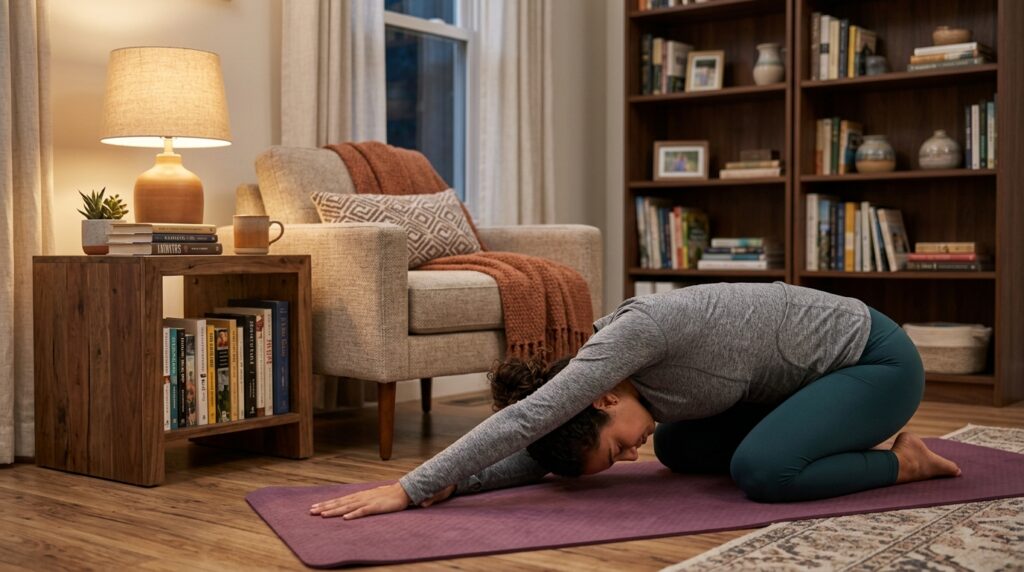
5. Child’s Pose with Side Reach
- Kneel on the floor with your knees comfortably apart.
- Sit your hips back toward your heels.
- Walk your hands forward and lower your chest toward the floor, resting your forehead on the mat, a cushion, or your hands (Child’s Pose).
- Stay here for about 20 seconds, breathing slowly.
Then add a side stretch:
- From center, walk both hands to the left side.
- You should feel a stretch along the right side of your ribcage and under your shoulder.
- Hold for 15–20 seconds.
- Walk your hands to the right side and repeat on the other side.
Breathing tip
Breathe into the side of your ribs that’s on the “open” side of the stretch.
Imagine your breath expanding into the tight spaces around your shoulder blade and ribs.
Comfort tips
- If your knees are uncomfortable, widen your stance or put a folded blanket under them.
- If your forehead doesn’t reach the floor, put a cushion or folded towel underneath for support.
Regular stretching and strengthening like this, combined with posture awareness, can help reduce the impact of forward head posture and rounded shoulders on your daily comfort.
Everyday Habits to Support Better Posture
Exercises help, but your posture throughout the day matters just as much.
Here are a few simple changes you can start today.
1. Raise Your Screen to Eye Level
- Adjust your monitor so the top of the screen is near eye level.
- If you use a laptop, try a stand or a stack of books plus an external keyboard.
This reduces how much your head has to jut forward and how often your shoulders collapse inward.
2. Set a “15-Minute Upper Body Reset” Time
Pick one time each day—morning, lunch, or evening—when you’ll do this routine.
- For example: “Every weekday at 9 pm, I do my 15-minute posture reset.”
- Set a repeating reminder on your phone or calendar.
Consistent daily habits like this often matter more than occasional long sessions when it comes to posture and chronic neck or shoulder tension.
3. Move at Least Once an Hour
On days when you sit a lot:
- Stand up at least once every 60 minutes.
- Roll your shoulders, gently stretch your neck, or walk for 1–2 minutes.
Even tiny breaks help interrupt the cycle of slouching and forward head posture.
Related Routines You Might Like
- 15-Minute Neck and Shoulder Stretch Routine for Desk Workers – A focused routine to release tension around your neck and upper shoulders on busy workdays.
- 15-Minute Home Office Posture Reset: Gentle Stretches to Ease Back and Neck Tension – Great for remote workers who sit at a computer most of the day.
- 15-Minute Foam Roller Posture Reset: Restore Your C-Curve Safely After Work – A gentle foam roller routine to support your natural spinal curves after long hours of sitting.
Frequently Asked Questions
Q1. How often should I do this 15-minute posture reset?
A: Ideally, do it once a day on days when you spend a lot of time sitting or looking at screens.
If that’s too much, start with 3 times a week and build up as it becomes a habit.
Q2. How long will it take to see changes in my posture?
A: Everyone is different, but many people notice less stiffness and a slightly more upright feeling within 2–3 weeks of doing these stretches regularly.
Visible posture changes can take longer, especially if you’ve had rounded shoulders or forward head posture for years.
Q3 Can I do this routine if I already have neck or shoulder pain?
A: If your pain is mild and feels like everyday stiffness, you can try the routine gently and see how your body responds.
If you have sharp pain, numbness, tingling, or symptoms that radiate into your arms, stop and consult a healthcare professional before continuing.
Q4. Do I need any equipment for this routine?
A: No special equipment is required.
A yoga mat or folded blanket can make it more comfortable, and a chair helps with the seated stretches.
If you enjoy this and want to add tools later, you can explore gentle resistance bands or posture-focused foam roller routines.
Learn More
For more on posture, neck and shoulder health, and exercise:
- Harvard Health – Is it too late to save your posture?
Explains how strengthening and stretching your upper back, chest, and core can improve posture and reduce pain, with practical exercise examples.
https://www.health.harvard.edu/exercise-and-fitness/is-it-too-late-to-save-your-posture - Harvard Health – Posture and back health
Overview of how posture affects back health and simple moves, like shoulder blade squeezes and chest stretches, to stand taller.
https://www.health.harvard.edu/pain/posture-and-back-health - Physio-Pedia – Forward Head Posture
Clinical overview of forward head posture, its causes, and its relationship to neck pain and modern device use.
https://www.physio-pedia.com/Forward_Head_Posture
Leave a Reply