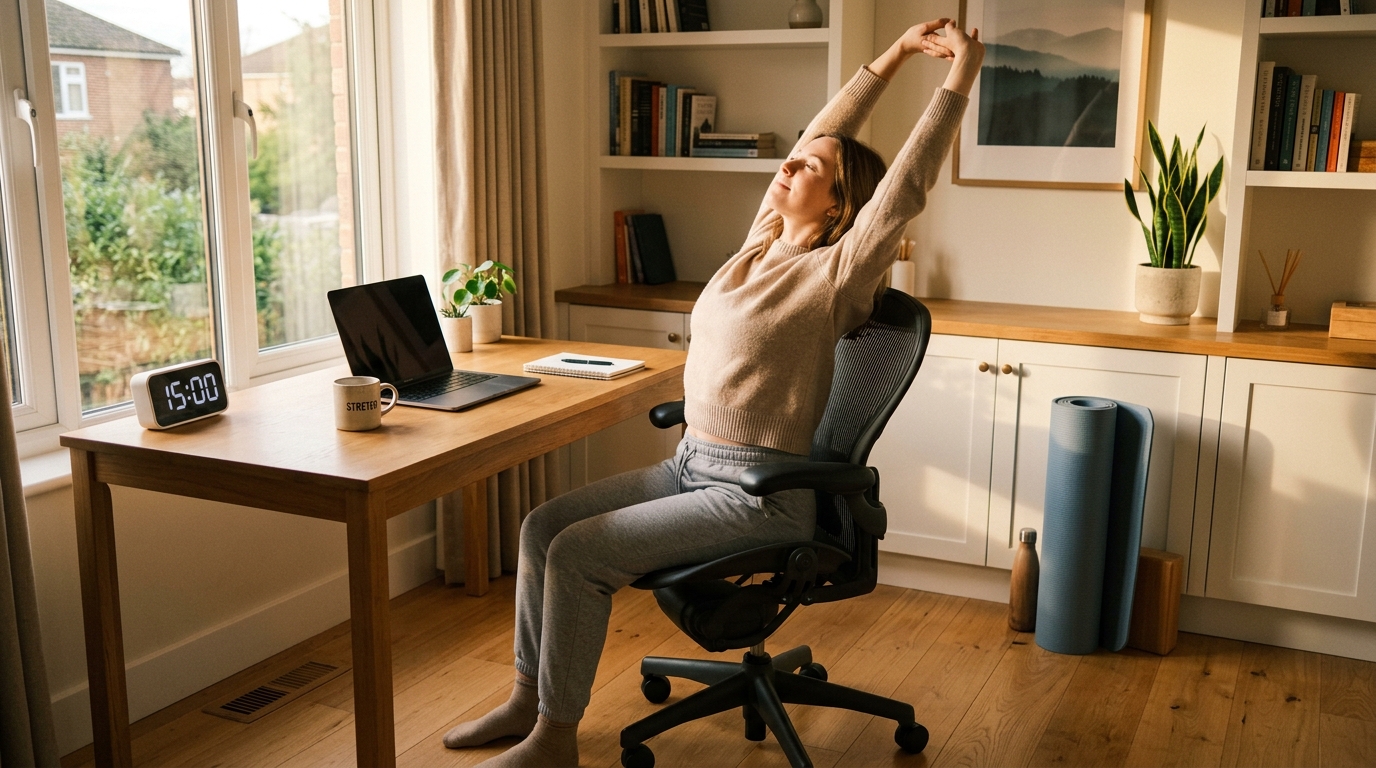
When Sitting All Day Turns Your Back and Shoulders into a Rock
If you work from home or spend long hours at a desk, you may recognize this pattern: the day starts fine, but by late afternoon your lower back feels dull and heavy, the back of your neck is tight, and your shoulders feel like concrete. Your hand drifts to the back of your neck, you roll your shoulders a few times, and then go right back to the same hunched position.
Health information from public organizations repeatedly warns that long periods of slouched sitting can increase the risk of neck, shoulder, and lower back problems, and that regular posture breaks and gentle stretching are important for prevention. This 15-minute home‑office posture reset routine is designed as a light, everyday way to “reset” your posture, release tension around your pelvis and spine, and make it easier to sit in a more neutral position again.
I tested this routine on days when my hips and lower back felt tired from working at my laptop, and even one 15‑minute block made my body feel noticeably lighter for the rest of the evening.
Important Safety Note Before You Start
This routine is for mild stiffness and everyday fatigue from sitting, not for diagnosing or treating serious pain or spine disease. If your symptoms are severe, sudden, or persistent—such as sharp pain, strong numbness, unexplained weakness, or pain that travels down your leg—talk with a doctor or physical therapist before using this routine or any posture devices.
During the exercises you should feel gentle pulling or mild discomfort, never sharp, burning, or electric-like pain. If you notice dizziness, strong tingling, or pain that gets worse, stop immediately and rest.
What This 15-Minute Posture Reset Does
Long hours of sitting, especially if you tuck your pelvis under and round your shoulders forward, can gradually shift your “default” posture into a slouched shape. Over time, this can stress the discs, joints, and muscles around your spine and may contribute to back pain, neck tension, and even headaches.
The goal of this 15‑minute routine is to:
- Gently release tension in your pelvis and lower back
- Help your spine find a more neutral, stacked alignment
- Relax your neck and shoulders at the end
You can do the whole sequence on a yoga mat or soft rug. A small cushion or pillow under your lower back or head is optional if it feels more comfortable.
15-Minute Posture Reset Routine at a Glance
- Pelvis and lower back release: 8 minutes
- Spine alignment and chest opening: 5 minutes
- Neck and shoulder relaxation while seated: 2 minutes
You do not need any special equipment to benefit from this routine. Posture chairs, cushions, and lumbar supports can help you maintain a neutral position while sitting, but the core of your posture care is still regular movement and gentle stretching.
Step 1 – Pelvis and Lower Back Release (About 8 Minutes)
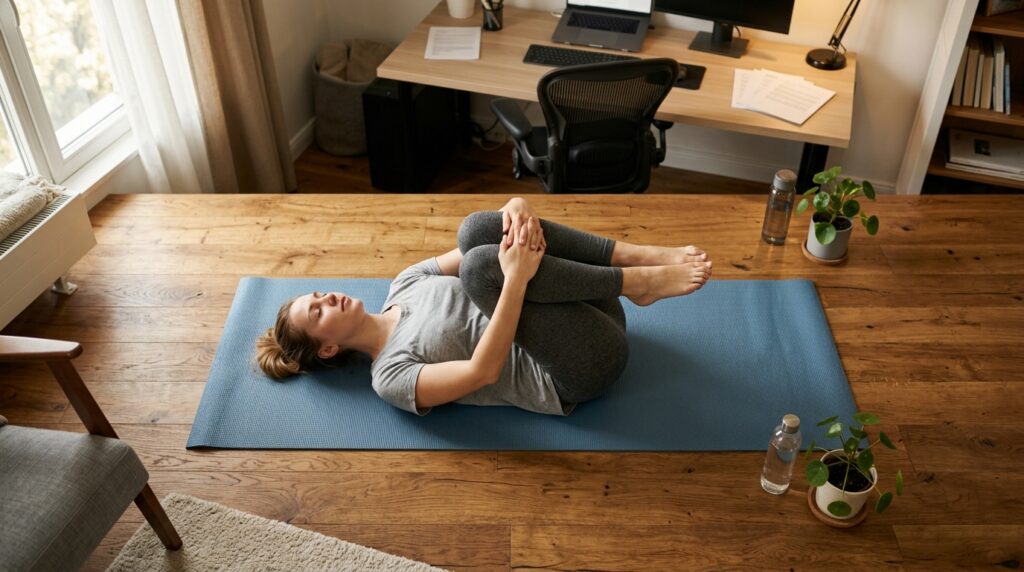
1. Knees-to-Chest Hug (1–2 Minutes)
- Lie on your back on a mat, looking up at the ceiling.
- Gently pull both knees toward your chest and wrap your arms around your shins or the backs of your thighs.
- Let your lower back sink toward the floor so there is only a small space under your spine.
- Breathe in through your nose and slowly out through your mouth, feeling your belly soften as you exhale.
If your lower back feels too tight, do not pull your knees all the way in. Stop at the point where you feel a gentle stretch rather than strain.
2. Bridge Pose (2–3 Minutes)
- From lying on your back, place your feet flat on the floor about hip‑width apart, heels roughly a hand’s length away from your hips.
- Inhale, then exhale as you gently lift your hips and lower back off the floor.
- Aim for a line from your shoulders through your hips to your knees, but only go as high as feels comfortable.
- Hold for about 5 seconds, then slowly roll your spine back down to the mat, one segment at a time.
Repeat 8–10 times. If your lower back hurts, reduce the height and focus on a small pelvic lift instead of a big bridge.
3. Lying Side-to-Side Spinal Twist (2–3 Minutes)
- Stay on your back and bend your knees with your feet flat on the floor, knees and feet together.
- Stretch your arms out to the sides in a T shape.
- Inhale, then exhale as you gently lower both knees toward the right while turning your head to the left.
- You should feel a mild twist through your lower back and side, not a sharp pinch. Hold for 20–30 seconds.
- Return to the center and repeat on the other side.
Alternate sides for 3–4 rounds. If you feel sharp or electric pain in your back or legs, reduce the twist angle and move only within a comfortable range.
If you want more ideas for full routines that focus on your lower back and hips after sitting, you might also like the 15-Minute Back Stretch Routine for Desk Workers or the 15-Minute Stretch Routine to Release Your Back and Hips After a Long Drive.
Step 2 – Wall-Based Chest Opening and Spine Alignment (About 5 Minutes)
4. Wall “W” for Upper Back and Shoulders (3 Minutes)
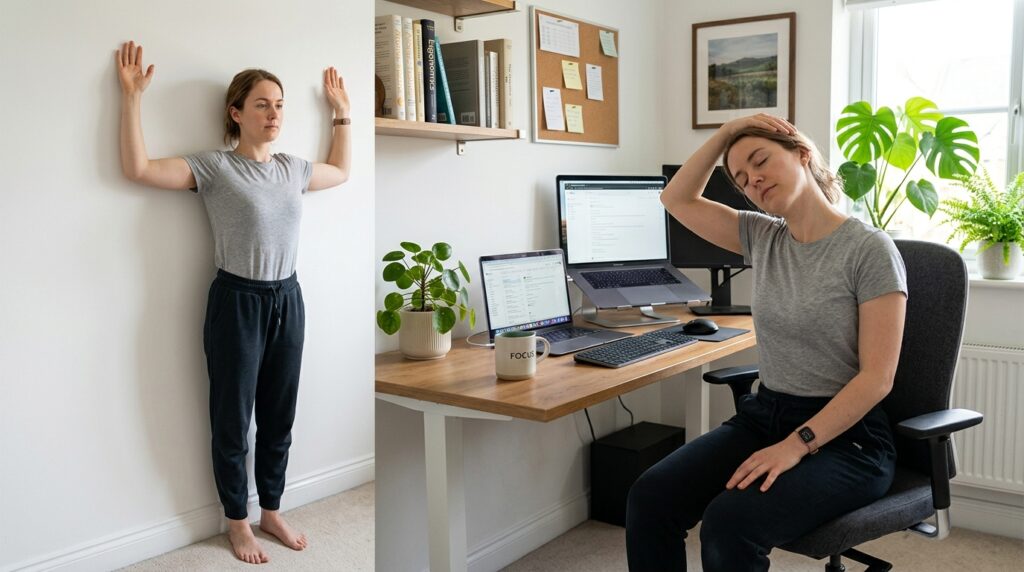
- Stand with your back against a wall so that the back of your head, shoulder blades, and pelvis lightly touch the wall.
- Raise your arms to the sides and bend your elbows to form a “W” shape, with the backs of your hands resting against the wall.
- Inhale, then as you exhale, gently press the backs of your hands and elbows into the wall without arching your lower back.
- Hold for 10 seconds, then relax.
Repeat 6–8 times. You should feel your chest open and your shoulders gently moving back from their rounded position. If your shoulders hurt, try doing the exercise with your elbows slightly lower.
This kind of gentle wall exercise can help remind your spine of a more neutral alignment, especially if your everyday posture has drifted into a rounded, forward‑head position.
Step 3 – Seated Neck and Shoulder Release (About 2 Minutes)
You can finish the routine seated on your desk chair.
5. Side Neck Stretch and Shoulder Shrugs (2 Minutes)
- Sit upright with your lower back supported, feet flat on the floor.
- Place your right hand over the left side of your head and gently tilt your head toward your right shoulder.
- Stop when the left side of your neck feels a comfortable stretch; hold for 15 seconds, breathing slowly.
- Switch sides and repeat.
Then:
- Lift both shoulders up toward your ears as you inhale, then drop them down as you exhale, letting them fall heavily.
- Repeat this relaxed shoulder shrug 10 times.
Many people notice that after just a couple of minutes, their neck and shoulders feel lighter and less “locked” than before.
If you need a longer, neck‑focused sequence for especially tight days, you can also use the 15-Minute Neck and Shoulder Stretch Routine for Desk Workers.
What About Posture Chairs, Cushions, and Lumbar Supports?
You can do this entire routine without any special tools. However, if you sit for many hours most days, posture devices can make it easier to maintain a neutral spine between stretching sessions.
Examples include:
- Posture chairs or cushions that help keep your pelvis upright instead of rolling backward
- Lumbar supports that follow the natural curve of your lower back
It is important to remember:
- These products are not medical devices that treat disc problems or spine disease.
- They are everyday support tools that make healthy sitting positions easier to maintain.
When choosing a posture cushion or lumbar support, consider:
- Cushion thickness and resilience – It should not flatten completely after a short time.
- Material – Memory foam or other elastic materials that gently support your pelvis and lower back.
- Non‑slip design – A base that does not slide easily on your chair.
Used well, these tools can reduce pressure on your pelvis and lower back so you feel less drained after a long day of sitting. But they work best when combined with regular movement and stretching, not as a replacement.
Everyday Ways to Use This Routine
Use Short Versions During the Day
- After lunch or a long meeting, do only Steps 1–3 (pelvis and lower back release) for 5–10 minutes.
- This can significantly reduce afternoon heaviness in your lower back and hips.
Use the Full Routine After Work
- At home in the evening, run through all five steps for the full 15 minutes.
- Treat it as a “reset time” to clear out the stiffness that built up during your workday.
Use a Gentle Version Before Bed
- At night, focus on Step 3 (spinal twist) and Step 5 (neck and shoulder release) with slower breathing.
- Relaxing your back and shoulders before sleep can make it easier to fall asleep comfortably.
Fifteen minutes can feel long when you are tired, but it is about the same time as watching a short video on your phone. If you keep this habit for a week, many people notice small but real changes like “my back feels less tight” or “my shoulders don’t ache as quickly.”
If any stretch makes your pain feel worse, or if you experience dizziness, numbness, or unusual tingling, stop immediately. In those cases, it is safer to seek medical advice from an orthopedic or rehabilitation specialist.
Related Routines You Might Like
- 15-Minute Back Stretch Routine for Desk Workers – A focused lower‑back sequence for long days at your computer.
- 15-Minute Neck and Shoulder Stretch Routine for Desk Workers – A detailed routine for stubborn neck and shoulder tension.
- 15-Minute Full-Body Recovery Stretch After Air Conditioning Fatigue – A gentle full‑body option for days when cold air has left your muscles feeling heavy and stiff.
Frequently Asked Questions
Q1. How often should I do this 15-minute posture reset routine?
If you sit for long periods most days, aim to do the full routine 3–5 days per week. On busy days, even a shorter 5–10 minute version focusing on the pelvis and lower back can help. The key is consistency rather than perfection.
Q2. Can I do this at the office, or only at home?
You can adapt most of the routine to any quiet space with a mat or soft surface. At the office, you might use only the lying and wall exercises at home, and rely on the seated neck and shoulder stretches plus short walks during work hours.
Q3. Do I need a posture chair or cushion for this routine to work?
No. The routine is designed to stand on its own without special equipment. Posture chairs, cushions, and lumbar supports can make it more comfortable to maintain a neutral posture, but they cannot replace regular movement or stretching.
Q4. What if my pain is sharp or goes down my leg?
Sharp, burning, or electric-like pain, or pain that travels into your arm or leg, can be a sign of nerve irritation or other serious issues. In that case, stop the exercises and consult a qualified healthcare professional before continuing.
Learn More
For more on posture, sitting, and musculoskeletal health, see:
- Mayo Clinic – Office Ergonomics: Your How-To Guide
Offers practical, step-by-step advice on choosing a chair, adjusting your desk and monitor, and setting up your keyboard and mouse to reduce strain on your neck, shoulders, and lower back during long workdays.
https://www.mayoclinic.org/healthy-lifestyle/adult-health/in-depth/office-ergonomics/art-20046169 - Mayo Clinic – Home Office Ergonomics Tips
Summarizes key home‑office setup tips, including chair height, monitor distance, and how to keep your joints comfortable while working at a computer.
https://newsnetwork.mayoclinic.org/discussion/home-office-ergonomics-tips/ - CCOHS – Working in a Sitting Position: Good Body Position
Provides detailed recommendations for a healthy sitting posture, including ideal joint angles, monitor height, and the importance of changing position regularly to help prevent musculoskeletal discomfort.
https://www.ccohs.ca/oshanswers/ergonomics/sitting/sitting_position.html
Leave a Reply