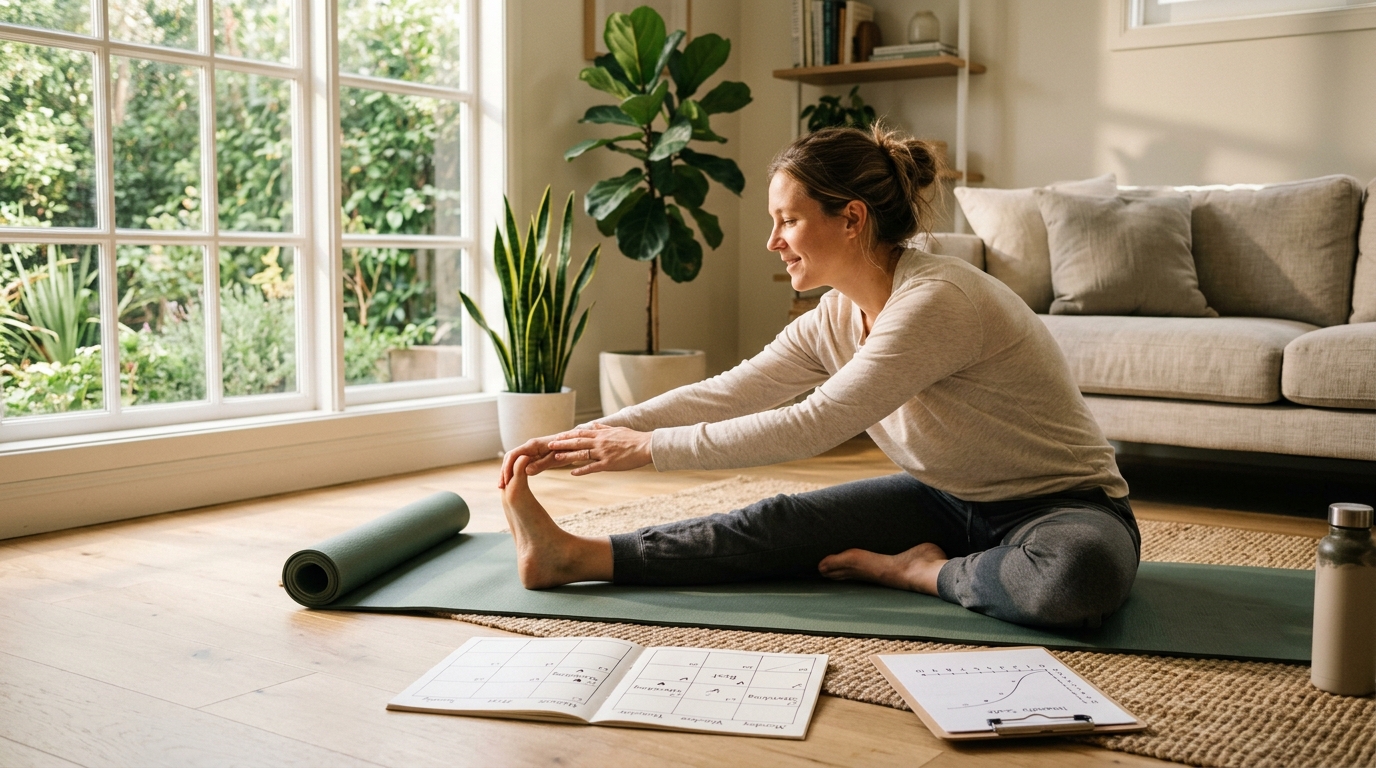
When You Hear “Stretch Every Day” and Feel Overwhelmed
If you work or study at a desk all day, you have probably heard that you “should stretch every day” to prevent stiffness and poor posture. Then you open a video or blog and see a long list of stretches, plus mixed messages like “stretch daily” versus “2–3 times per week is enough,” and it is hard to know what is actually realistic for your life.
The good news is that you can improve flexibility and feel less stiff without perfect daily stretching marathons. This guide explains how often to stretch, how hard to stretch, and how long to hold each position, plus a simple 15‑minute routine you can do a few times a week.
Important Safety Note Before You Start
This routine is for mild stiffness and everyday fatigue, not for diagnosing or treating serious pain or disease. If your symptoms are severe, sudden, or persistent—such as sharp pain, strong numbness, unexplained weakness, or swelling—talk with a doctor or physical therapist before starting or changing your stretching routine.
Stretching should feel like gentle tension or mild discomfort, never sharp or burning pain. Stop right away and seek medical advice if stretching makes your pain worse or causes dizziness, strong tingling, or unusual bruising.
Basic Principles: Frequency, Intensity, and Time
1. How Often Should You Stretch?
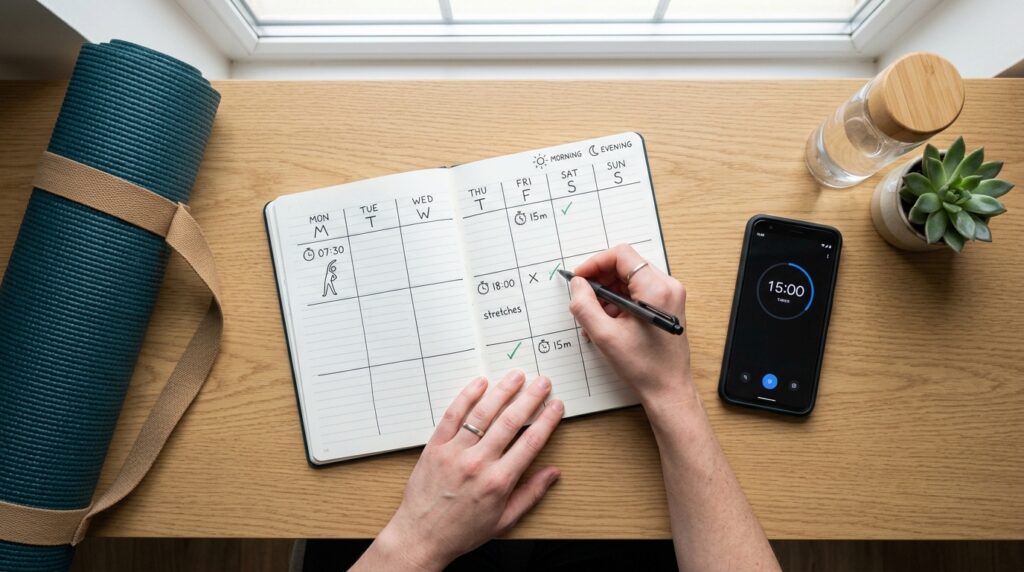
Major flexibility guidelines from health organizations suggest that stretching the major muscle groups at least 2–3 days per week is enough for general flexibility and posture, and that doing it more often (up to most days of the week) can bring additional benefits as long as it feels sustainable.
For beginners, a good starting point is:
- 2–3 sessions per week, about 15 minutes each
- Once that feels easy, you can increase to 4–5 sessions per week if you like
Stretching every single day can be helpful, but it is not mandatory. For most busy people, “three 15‑minute sessions per week” is a more realistic and sustainable target than an all‑or‑nothing daily plan.
If you want ready‑made 15‑minute sequences you can plug into these days, you can also use routines like the 15-Minute Full-Body Stretch Routine for Long Study Sessions on your stretching days.
2. How Intense Should a Stretch Feel?
Many hospital and sports medicine resources describe the ideal stretching intensity as:
- Inside your normal range of motion
- A feeling of mild tension or slight discomfort, not actual pain
- Something you can breathe through calmly
A simple 0–10 scale can help:
- 1–3: light pulling or gentle tension, feels comfortable
- 4–6: moderate stretch, you feel it clearly but can breathe and talk normally
- 7+: sharp, burning, or “I have to hold my breath” pain – too much
For beginners, aim for 2–3 out of 10 at first. As your body adapts, you can gradually work up to 4–5 out of 10 in some positions. When a stretch feels like 7 or higher, back off immediately.
3. How Long Should You Hold Each Stretch?
Many flexibility guidelines recommend something like:
- 10–30 seconds per stretch for most adults
- Up to 30–60 seconds for older adults or specific rehab goals
For our 15‑minute routine, you can:
- Start with 10–15 seconds per position
- As you get used to it, increase to 20–30 seconds per position
Holding one stretch far beyond 30–60 seconds does not dramatically increase benefits for most people. Instead of one very long hold, it is usually more effective to do shorter holds repeated a few times in a comfortable range.
A 15-Minute Beginner Stretching Routine (2–3 Times Per Week)
This routine is an example you can use on your stretching days:
- 5 minutes: neck and shoulders
- 5 minutes: lower back and hips
- 5 minutes: legs and a short breathing finish
For each position:
- Hold for about 15 seconds at a 2–3 intensity if you are a beginner
- Repeat 2 times before moving on
- Breathe slowly and never bounce
Neck and Shoulders (About 5 Minutes)
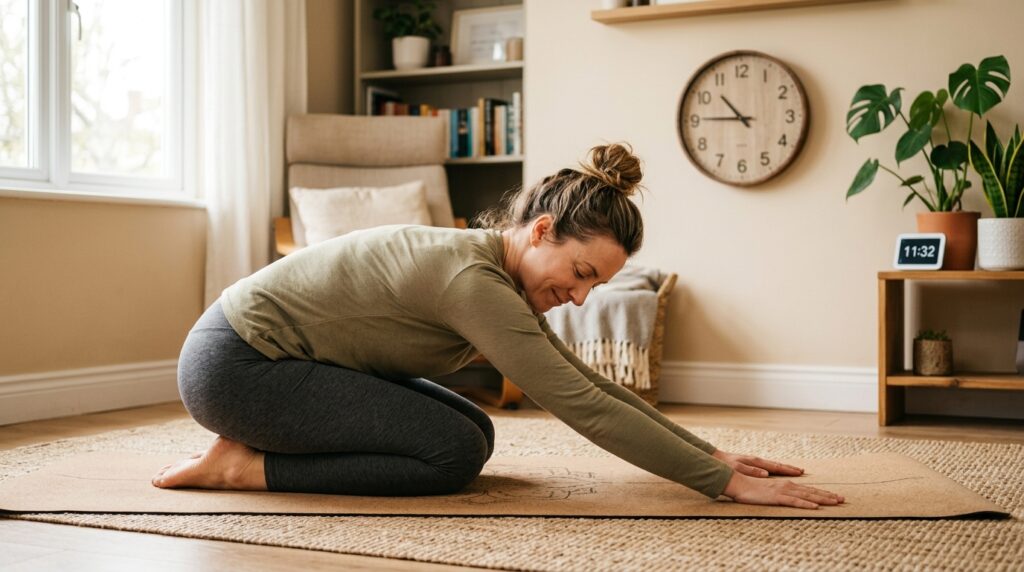
1. Side Neck Stretch (15 seconds each side × 2 sets)
- Sit or stand comfortably.
- Place your right hand over the left side of your head and gently tilt your head toward your right shoulder.
- Stop when you feel a light stretch along the left side of your neck (around 2–3 out of 10).
- Hold for 15 seconds, breathing slowly, then switch sides.
2. Chest and Shoulder Stretch (15 seconds × 2 sets)
- Clasp your hands behind your back.
- Gently straighten your arms and lift your hands slightly away from your lower back as you open your chest.
- You should feel a mild pull across the front of your shoulders and chest.
- Hold for 15 seconds, then relax and repeat once more.
If you often feel tight from desk work, you may also like the 15-Minute Neck and Shoulder Stretch Routine for Desk Workers for days when you want a deeper focus on the upper body.
Lower Back and Hips (About 5 Minutes)
1. Seated Spinal Twist (15 seconds each side × 2 sets)
- Sit on the floor with your legs extended.
- Bend your right knee and place your right foot outside your left thigh.
- Place your left elbow outside your right knee and gently twist your torso to the right.
- You should feel a stretch along the side of your lower back and hip at about 3–4 out of 10.
- Hold for 15 seconds, then switch sides.
2. Lying Knees-to-Chest Stretch (15 seconds × 2 sets)
- Lie on your back and gently hug both knees toward your chest.
- Keep your shoulders relaxed on the floor.
- You should feel a comfortable stretch in your lower back and hips, not pain.
- Hold for 15 seconds, slowly lower, and repeat.
For evenings when your lower back feels especially tight, you can pair this with the 15-Minute Bedtime Stretch Routine to Reduce Lower Back Strain.
Legs and Finish (About 5 Minutes)
1. Seated Hamstring Stretch (15 seconds × 2 sets)
- Sit with your legs straight in front of you.
- Hinge forward from your hips and reach toward your shins or feet without forcing.
- Stop when the backs of your thighs feel a 3–4 out of 10 stretch.
- Hold 15 seconds, then relax and repeat.
2. Calf Stretch Against a Wall (15 seconds each side × 2 sets)
- Stand facing a wall and step your right foot back.
- Keep your back heel on the floor and your back knee straight as you lean toward the wall.
- You should feel a gentle stretch in the right calf.
- Hold for 15 seconds, then switch sides.
3. Easy Breathing (1–2 Minutes)
- Sit or lie comfortably.
- Inhale slowly through your nose and exhale gently through your mouth.
- Repeat for 1–2 minutes to let your body settle before you move on with your day.
Everyday Tips for Applying These Guidelines
Start with 2–3 Days per Week, Then Add More If You Like
If you try to stretch every day from the start, it is easy to burn out and stop completely. Instead:
- Choose 2–3 fixed days (for example, Tuesday, Thursday, and Saturday evenings at 9 p.m.)
- Do your 15‑minute routine on those days
- Once that feels normal, you can add another one or two sessions if you want
What matters most is consistency over months, not perfection in one week.
Use the 0–10 Intensity Scale as a Safety Check
During each stretch, quickly ask yourself:
- “Is this around 2–4, or did I accidentally push into 7 or more?”
If you ever notice:
- Sharp, stabbing, or burning pain
- Strong numbness or tingling
- Pain that feels worse the next day
reduce your intensity, shorten the hold time, or stop and talk with a professional. Stretching should help you feel better, not worse.
Combine Stretching with Better Everyday Habits
Stretching is helpful, but it cannot fully undo:
- Long days of sitting without breaks
- Very poor posture for many hours
- Heavy lifting done with bad technique
Whenever you can, combine your stretching routine with:
- Short movement breaks during the day
- Slightly better sitting posture at your desk
- Light walking on off days
If you want simple full‑body options to plug into your week, you can also rotate routines like the 15-Minute Morning Stretch Routine to Gently Wake Up Your Body or the 15-Minute Full-Body Recovery Stretch After Air Conditioning Fatigue.
Related Routines You Might Like
- 15-Minute Full-Body Stretch Routine for Long Study Sessions – A gentle sequence to undo stiffness after hours of reading or laptop work.
- 15-Minute Morning Stretch Routine to Gently Wake Up Your Body – A light routine to ease into movement at the start of your day.
Frequently Asked Questions
Q1. Do I really have to stretch every day?
No. For most people, stretching 2–3 times per week is enough to support general flexibility and comfort. If you enjoy stretching and it feels good, you can do it more often, but daily stretching is not mandatory. Focus on a realistic schedule you can actually maintain.
Q2. How long will it take to notice a difference?
If you do a 10–15 minute routine 2–3 times per week at a comfortable intensity, many people start to feel a bit less stiff within a few weeks. Bigger changes in flexibility and posture usually take several weeks to a few months of consistent practice. It is normal for progress to be gradual.
Q3. What if stretching makes my pain worse?
Stop and reassess. You may be:
- Pushing too hard (above 6–7 out of 10)
- Holding positions too long
- Stretching an area that is irritated or injured
Reduce the intensity, shorten the holds, and avoid any movement that causes sharp pain. If your pain persists, gets worse, or includes numbness, weakness, or swelling, talk with a healthcare professional before continuing.
Q4. Is stretching alone enough to fix my posture or joint problems?
Stretching can help muscles feel less tight and may support better posture, but it is only one part of the picture. Strength training, ergonomic adjustments, and healthy movement habits are also important. If you have specific posture or joint problems, a physical therapist or other professional can give you a tailored plan.
Learn More
For more on stretching and flexibility guidelines, see:
- Mayo Clinic – Stretching: Focus on Flexibility
Explains basic stretching principles, including how often to stretch, how intense it should feel, and how long to hold positions.
https://www.mayoclinic.org/healthy-lifestyle/fitness/in-depth/stretching/art-20047931 - UC Davis Health – Flexibility | Sports Medicine
Provides practical tips on stretching safely, choosing appropriate frequency, and protecting joints while improving flexibility.
https://health.ucdavis.edu/sports-medicine/resources/flexibility - Harvard Health – The Importance of Stretching
Discusses the role of stretching in healthy aging and musculoskeletal health, and how to fit stretching into a weekly routine.
https://www.health.harvard.edu/healthy-aging-and-longevity/the-importance-of-stretching - ACSM Flexibility Training Exercise Design Guidelines (summary)
Outlines evidence-based recommendations to stretch major muscle groups at least 2–3 days per week, holding each stretch 10–30 seconds and repeating 2–4 times to reach about 60 seconds per muscle.
https://www.anatomytrains.com/wp-content/uploads/manual/acsm.docx
Leave a Reply