
Why You Need an Evening Posture Reset
If your days are a mix of sitting at your desk, standing to serve customers, and driving home in traffic, your body rarely gets a real break.
By the time evening comes, your back, hips, shoulders, and neck may all feel stiff, but you are too tired for a full workout.
Research on prolonged sitting shows that staying in one position for too long can increase stiffness and musculoskeletal pain, especially in the lower back.
Gentle movement and stretching, even in short sessions, can help reduce discomfort and keep your spine and joints moving more freely.
This 15-minute posture reset routine is designed for people who sit, stand, and drive throughout the day and want a simple way to “bring their body back to neutral” before bed.
I tested this routine on days when my back felt tight after writing and driving for hours, and even one 15-minute block made the rest of the evening feel lighter.
Important Safety Note
This routine is for mild stiffness and fatigue, not for treating serious pain or disease.
If your symptoms are severe, new, or persistent, or if you have been diagnosed with a spine or joint condition, consult a healthcare professional before continuing.
If any exercise causes sharp, shooting, or worsening pain, stop the movement and skip that exercise.
Use a yoga mat or a soft but stable surface, move slowly, and stay within a comfortable range of motion.
Overview: 15-Minute Evening Posture Reset
This routine takes about 15 minutes and focuses on the areas most affected by sitting, standing, and driving:
- 5 minutes – Upper body (neck, shoulders, chest)
- 7 minutes – Lower back and hips (lumbar spine, pelvis)
- 3 minutes – Gentle full-body release to calm your system
You can do it on a yoga mat, carpet, or a firm rug.
No equipment is required, but a small pillow or folded towel can make some positions more comfortable.
If you already use our 15-Minute Home Office Posture Reset or 15-Minute Stretch Routine After a Long Drive, this routine fits perfectly as an evening “cool-down” you can repeat most days.
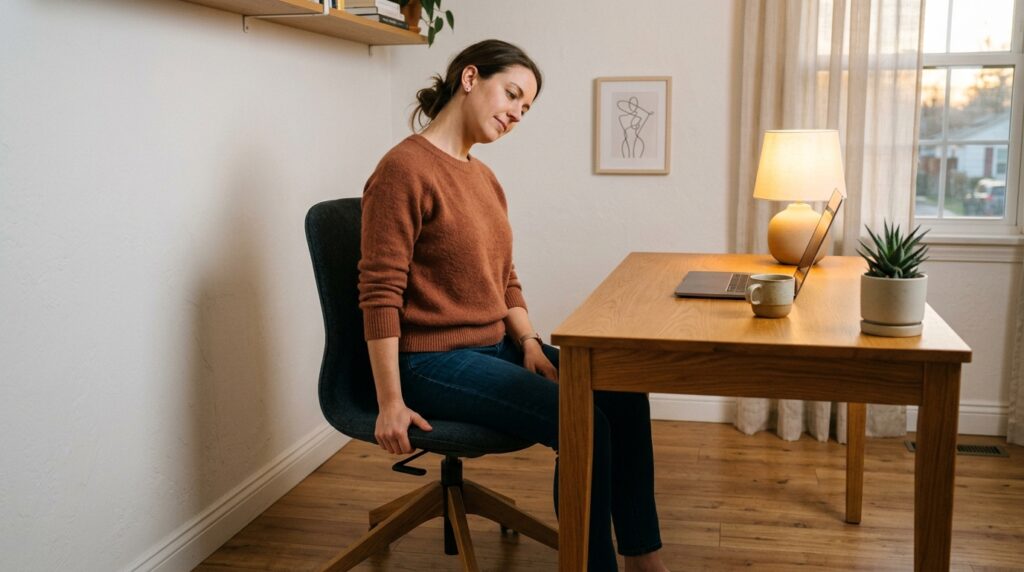
Step 1 – Neck and Shoulder Release (1–2 Minutes)
Seated Side Neck Stretch
Start position
Sit upright on a chair with your feet flat on the floor and your hips close to the front edge of the seat.
How to do it
Hold the side of the chair with your right hand.
Place your left hand gently over the right side of your head and slowly tilt your head to the left, as if you are resting it toward your shoulder.
Hold for 15–20 seconds, then switch sides.
Repeat 2 times on each side.
Breathing
Inhale and imagine the side of your neck getting longer.
Exhale and let your shoulder and jaw soften and drop.
Safety tips
Do not yank or pull your head.
You should feel a gentle stretch, not a sharp, electrical, or pinching pain. If you do, ease off immediately.
Step 2 – Open Your Chest After a Day of Hunching (3 Minutes)
Standing Chest-Opening Stretch
Start position
Stand with your feet hip-width apart, knees soft, and your weight evenly distributed.
How to do it
Interlace your fingers behind your back.
Inhale as you gently lift your chest forward and up, creating space across the front of your shoulders.
As you exhale, slowly lift your hands a little away from your hips, only as far as is comfortable.
You should feel a broad, open stretch across your chest and the front of your shoulders.
Hold for about 15 seconds, return to neutral, and repeat 3–4 times.
Breathing
Inhale and feel your chest widen.
Exhale and let your shoulder blades slide down your back.
Safety tips
Avoid pushing your lower back into a deep arch.
Gently engage your lower abs so your ribs stay stacked over your pelvis.
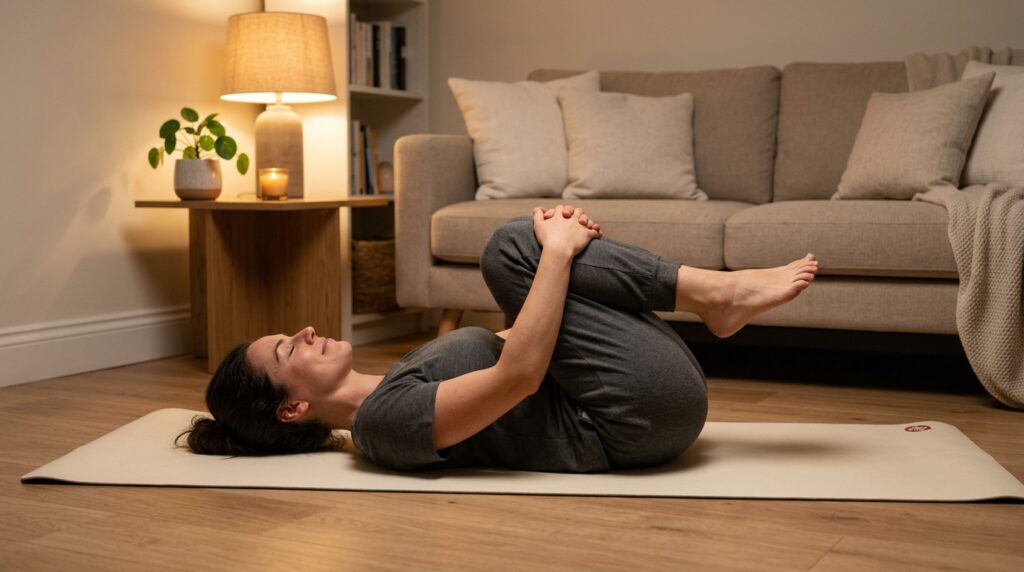
Step 3 – Lower Back and Pelvis Reset: Single-Knee Hug (3 Minutes)
Supine Knee-to-Chest Stretch
Exercises that gently flex the spine and move the hips can ease tension in the lower back after long periods of sitting.
Start position
Lie on your back on a mat or carpet with both legs extended.
How to do it
Pull your right knee toward your chest, holding either your shin or the back of your thigh.
Keep your left leg relaxed on the floor.
Hold for 20–30 seconds while breathing slowly.
Switch sides and repeat with your left knee.
At the end, you can pull both knees toward your chest and gently hug them for another 20 seconds if it feels good.
Breathing
As you inhale, feel your lower back expand gently into the floor.
As you exhale, imagine the tension melting from your lower back and hips.
Safety tips
If you feel sharp pain in your lower back, hip, or groin, reduce the range or skip the exercise.
Keep your shoulders relaxed and your neck long.
Step 4 – Gentle Spinal Twist for Lower Back and Hips (4 Minutes)
Supine Knees-Over Twist
Gentle rotation helps mobilize the lumbar spine and hips without loading them, which can be especially helpful after standing or driving for hours.
Start position
Lie on your back with both knees bent and your feet hip-width apart.
Stretch your arms out to the sides in a T-shape.
How to do it
Inhale in the center.
As you exhale, slowly let both knees fall to one side, staying within a comfortable range.
Keep both shoulders as close to the floor as possible.
Hold the twist for 20–30 seconds, breathing deeply, then bring your knees back to center.
Repeat on the other side.
Do 2–3 rounds on each side.
Breathing
In the twist, take 3–4 slow breaths.
Each exhale, feel your waist, lower back, and outer hip gently lengthen.
Safety tips
If one shoulder lifts a lot, reduce the range of motion and keep your knees higher.
If you feel increased pain or tingling in your legs, come out of the pose and skip this exercise.
Step 5 – Hamstring and Calf Release (3 Minutes)
Supine Leg Raise With Gentle Stretch
Tight hamstrings and calves are common after long days of sitting and driving and can contribute to lower back tension.
Start position
Lie on your back with both knees bent.
How to do it
Lift your right leg and hold the back of your thigh with both hands.
Keep a slight bend in your knee.
Gently flex your foot so your toes move toward your shin.
You should feel a stretch in the back of your thigh and calf.
Hold for 20–30 seconds, then switch sides.
If you have time, repeat 2 sets per side.
Breathing
Inhale and imagine your leg lengthening.
Exhale and let the back of your thigh soften a little more.
Safety tips
Do not force your knee to straighten.
If your lower back lifts off the floor, bend the leg that remains on the ground and place that foot flat on the floor for more support.
Everyday Posture Tips to Support This Routine
Doing this 15-minute routine once a day is powerful, but small changes throughout the day matter too.
If possible, pick a consistent time—such as 15 minutes before your shower or 15 minutes before bed.
When your body learns, “At this time, we always stretch,” it becomes easier to stick to the habit.
During the day, try to avoid letting your pelvis tilt too far backward when you sit.
Sit with your hips slightly higher than your knees and your feet flat, and stand up at least once every 30–60 minutes to move and roll your shoulders.
Even a two-minute micro-break to gently roll your neck and shoulders can reduce how stiff you feel by the evening.
For a home-office-specific guide, you can also check our post on 15-Minute Home Office Posture Reset: Gentle Stretches to Ease Back and Neck Tension.
When to See a Professional
If you notice any of the following, it is better to get checked by a doctor or physical therapist:
- Strong, sharp, or worsening pain in your lower back, neck, or shoulders
- Numbness, tingling, or weakness in your legs or arms
- Visible changes in your posture that keep getting worse, such as a clearly tilted pelvis or uneven shoulders
In those cases, this routine can be too little or not the right type of movement for your situation.
A qualified professional can help you find a tailored plan and rule out serious conditions.
Related Routines You Might Like
- 15-Minute Home Office Posture Reset: Gentle Stretches to Ease Back and Neck Tension – Ideal if you work from home and spend most of the day at a computer.
- 15-Minute Stretch Routine to Release Your Back and Hips After a Long Drive – A focused sequence for days with lots of driving.
- 15-Minute Pelvis and Lower Back Reset Routine at Home: Gentle Stretches for Everyday Stiffness – A deeper focus on your lower back and pelvic alignment.
(Replace # with your actual internal URLs when publishing.)
Frequently Asked Questions
Q1. Can I do this routine every day?
Yes, most people can safely do this 15-minute routine daily as long as the movements feel comfortable and do not increase pain.
If you feel more sore the next day, reduce the time, range of motion, or frequency to every other day.
Q2. What if 15 minutes feels too long?
Start smaller.
If 15 minutes feels overwhelming, begin with just 5 minutes and do two or three of the exercises you find most helpful.
The goal is consistency, not perfection.
Once 5 minutes feels easy, you can gradually build up to the full 15-minute sequence.
Q3. Can I do this in the morning instead of at night?
Absolutely.
Morning can be a great time to loosen up stiffness from sleep and prepare your back and hips for the day.
If you sit or stand a lot for work, doing it in the evening may feel especially good, but choose the time you are most likely to repeat.
Some readers even do a shorter version in the morning and the full routine at night.
Q4. Is this routine enough to fix my back pain?
This routine can help ease mild stiffness and support better posture, but it is not a complete treatment for chronic or severe back pain.
For long-standing or intense pain, you may also need strength training, ergonomic changes, and guidance from a healthcare professional.
Use this as one supportive tool, not your only strategy.
Learn More
For more on posture, back health, and the role of gentle exercise, see:
- Mayo Clinic – Back exercises in 15 minutes a day
A step-by-step guide to simple exercises that help stretch and strengthen the back and supporting muscles.
https://www.mayoclinic.org/healthy-lifestyle/adult-health/in-depth/back-pain/art-20546859 - UCLA Health – Ergonomic and Proper Posture for Sitting
Practical tips on how to set up your chair, desk, and screen to reduce strain during long hours of sitting.
https://www.uclahealth.org/medical-services/spine/patient-resources/ergonomics-prolonged-sitting - Adverse Effects of Prolonged Sitting Behavior on the General Health of Office Workers
Research summary on how prolonged sitting is linked to musculoskeletal problems and why regular movement breaks matter.
https://pmc.ncbi.nlm.nih.gov/articles/PMC5618737/
Leave a Reply