
Why Your Back Feels Like a Stone in the Morning
You open your eyes and your body feels like a block of stone. Your lower back and neck are stiff, and even getting out of bed feels heavy and awkward. If you spend long hours sitting at a desk or working from home, you might notice that your back already feels tight before the day even begins.
When you sit in one position for long periods, the muscles around your spine can gradually tighten and weaken, which often shows up as morning stiffness or dull back and neck discomfort. Health organizations note that prolonged sitting is a risk factor for low back pain and other musculoskeletal problems, and they often recommend regular gentle movement and stretching as part of daily self-care.
This short routine is for mild, everyday stiffness and fatigue, not for treating serious pain or disease. If your symptoms are severe, new, or persistent—especially if you notice leg numbness, weakness, or visible changes in posture—consult a healthcare professional before continuing. I tested this 5-minute routine on mornings when my back felt locked up after a week of desk work, and even one round made it easier to stand up straight and start the day.
What This 5-Minute Spine Wake-Up Routine Does
This routine gently moves your spine from top to bottom right after you wake up:
- 1 minute – Full-body stretch in bed
- 1.5 minutes – Knees-to-chest stretch
- 1.5 minutes – Supine spinal twist to each side
- 1 minute – Cat–cow sequence on hands and knees
You can do the first three moves on your bed or on a mat, and the last move on the floor or a thicker rug. Back care guides often recommend starting with gentle movements like knee-to-chest, lower-back rotation, and cat–cow to restore spine mobility and reduce morning stiffness.
Step 1 – Full-Body Morning Stretch (About 1 Minute)
Starting Position
- Lie on your back on your bed or a mat, facing the ceiling.
- Let your body relax for a moment and notice how your back and shoulders feel.
How to Do It
- Reach both arms overhead and stretch them toward the wall behind you.
- At the same time, gently push your heels or toes away from you, as if you are trying to make your whole body longer.
- Inhale and lengthen from fingertips to toes, feeling your front body gently open.
- Exhale and let all the tension melt, allowing your body to soften back into the bed or mat.
- Repeat this slow stretch 3–4 times.
Breathing and Safety Notes
- As you inhale, imagine your belly gently rising and your ribcage expanding.
- As you exhale, imagine your shoulders and lower back sinking a little deeper into the surface.
- If your lower back or shoulders feel sensitive, do not force a hard stretch—aim for a light “longer” feeling rather than maximum reach.
Step 2 – Knees-to-Chest Stretch (About 1.5 Minutes)
Starting Position
- Stay lying on your back.
- Bend your knees so your feet are flat on the bed or floor.

How to Do It
- Slowly bring both knees toward your chest.
- Wrap your hands around your shins or behind your thighs—whichever feels more comfortable.
- Gently draw your knees closer until you feel a mild stretch in your lower back and hips.
- Try to keep your lower back resting lightly on the bed or mat.
- Hold for about 20 seconds, then release your legs.
- Repeat this hold one more time for a total of 2 sets.
Breathing and Safety Notes
- Breathe in through your nose and out through your mouth, letting your lower back and hips relax more with each exhale.
- If you feel discomfort in your lower back, reduce how far you pull your knees in and simply “hug” them lightly instead of pulling strongly.
- Stop if you feel sharp or shooting pain.
Knee-to-chest stretches are commonly used in back exercise programs to relieve lower back tension and gently mobilize the spine.
Step 3 – Supine Spinal Twist Left and Right (About 1.5 Minutes)
Starting Position
- Remain on your back with your knees bent and feet flat.
- Open your arms out to the sides at shoulder height so your body forms a “T” shape.
How to Do It
- Bring your knees together and keep your feet on the bed or mat.
- Inhale, then as you exhale, slowly lower both knees to the right side.
- Let your lower back and hips follow the movement in a comfortable range.
- Turn your head gently to the left if your neck allows, feeling a gentle twist through your spine.
- Hold for about 20 seconds while breathing slowly.
- Bring your knees back to the center, then repeat the twist to the left side with your head turning right.
- Do 1 set on each side. If you have time and your body feels good, you can repeat for up to 2 sets.
Breathing and Safety Notes
- Breathe naturally and imagine your back and ribs softening toward the bed with every exhale.
- Aim for a pleasant stretch sensation, not pain. Stop before your knees or shoulders feel strained.
- It is fine if your knees do not reach the bed; work within your comfortable range.
Gentle rotational stretches like this help improve spine mobility and reduce morning stiffness without requiring strong effort.
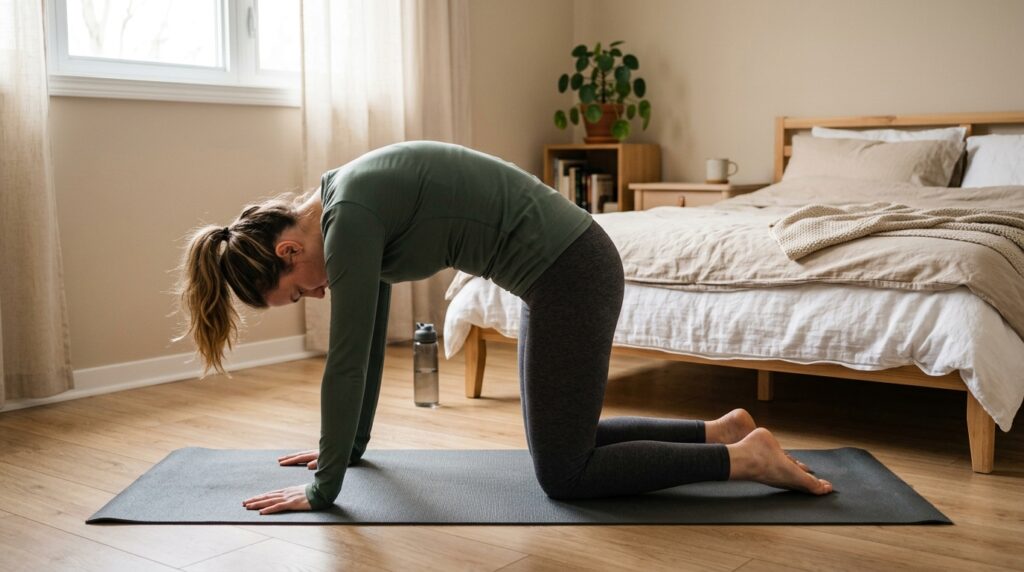
Step 4 – Cat–Cow to Align Your Spine (About 1 Minute)
Starting Position
- Carefully roll onto your side, then push yourself up to sitting and come onto the floor or a mat.
- Get into a hands-and-knees position: hands under shoulders, knees under hips, spine in a neutral, flat position.
How to Do It
- Inhale and slowly drop your belly slightly toward the floor while lifting your chest and tailbone—this is the “cow” position.
- Exhale and gently round your back toward the ceiling, pulling your belly in and letting your head drop—this is the “cat” position.
- Move smoothly back and forth between these two positions 6–8 times.
Breathing and Safety Notes
- Inhale as you move into the cow position, feeling your chest open and your lower back gently lengthen.
- Exhale as you round into the cat position, focusing on the space between each vertebra along your spine.
- Keep your neck relaxed and your gaze toward your belly or the floor; avoid jamming your head up or down.
Cat–cow sequences are widely recommended as gentle spine mobility exercises that help reduce stiffness and prepare the back for daily activities.
Everyday Habits to Support Your Spine
Short routines like this work best when combined with a few daily habits.
Practice Sitting with Your Pelvis in Neutral
After your morning stretch, pay attention to how you sit:
- Place both feet flat on the floor instead of tucking them under the chair.
- Slide your hips back so your buttocks touch the back of the chair.
- Gently tilt your pelvis so your lower back keeps a natural curve, rather than rounding into a “C” shape.
Ergonomic guides emphasize that supporting the lower back, keeping feet supported, and avoiding prolonged slouching help reduce stress on the spine during long sitting sessions.
Take Short Movement Breaks During the Day
Even with a good chair and posture, your back does not like being still for hours.
- Every 30–60 minutes, stand up for 1–2 minutes.
- Take a few steps, roll your shoulders, or repeat one of the simpler stretches from this routine.
Spine and workplace health resources often recommend these microbreaks to reduce muscle fatigue and stiffness from static postures.
When You Should See a Doctor Instead
This 5-minute routine is designed for mild, everyday stiffness and fatigue from sitting or sleeping in one position. It is not a treatment for serious pain or diagnosed conditions.
If you notice any of the following, stop the routine and talk with a doctor or physical therapist:
- Increasing or sharp back pain that does not improve.
- Leg numbness, tingling, or weakness.
- A feeling that your body is noticeably leaning or twisted to one side.
Guidelines for chronic low back pain recommend that care should be tailored and holistic, and they support exercise and education as part of self-care while also advising against relying solely on self-treatment when serious symptoms appear.
Frequently Asked Questions
Q1. Can I do this 5-minute routine if I already have back pain?
A: This routine is meant for mild stiffness and everyday tightness, not for strong or worsening pain. If you have diagnosed back problems, sharp pain, or leg symptoms, talk with a healthcare professional first and ask which movements are safe for your situation.
Q2. How often should I do this morning spine routine?
A: You can do it every morning as part of your wake-up routine. Many back care guides recommend daily gentle stretching, especially for people who sit a lot, because consistency matters more than long individual sessions.
Q3. Can I do these stretches in the evening too?
A: Yes. You can repeat the routine in the evening to help your back unwind after a long day of sitting or standing. If you already use a 15-minute evening stretch routine, you can add one or two of these moves at the beginning as a gentle warm-up.
Q4. Do I need a yoga mat or special equipment?
A: No. You can do the first three moves on your bed and the cat–cow on a rug or carpet. A mat can make the floor more comfortable, but it is optional; the most important part is moving gently and regularly.
Related Routines You Might Like
- 15-Minute Morning Stretch Routine to Gently Wake Up Your Body – A longer morning sequence that combines spine, shoulder, and hip stretches to ease you into the day.
- 15-Minute Home Office Posture Reset: Gentle Stretches to Ease Back and Neck Tension – A mid-day routine for remote workers to release stiffness from long sitting sessions.
- 15-Minute Pelvis and Lower Back Reset Routine at Home: Gentle Stretches for Everyday Stiffness – Focused on releasing the lower back and pelvis after long days of sitting or standing.
Learn More
For readers who want to explore more about back care, spine-friendly exercise, and managing stiffness, these resources are a helpful next step:
- Mayo Clinic – Back Exercises in 15 Minutes a Day
Demonstrates several gentle back stretches and strengthening exercises, including knee-to-chest and rotational stretches, with guidance on how often to do them.
https://www.mayoclinic.org/healthy-lifestyle/adult-health/in-depth/back-pain/art-20546859 - Clayton Heights Chiropractic – Best Morning Stretches to Prevent Back Injuries
Introduces simple morning stretches like cat–cow and knee-to-chest to improve spinal flexibility and reduce back tension, with safety tips for gentle practice.
https://claytonheightschiropractic.com/2024/09/morning-stretches-prevent-back-injuries/ - HSS – If You Have Back Pain When Sitting, Here’s How to Fix It
Offers practical advice on sitting posture, chair setup, and movement breaks to reduce back pain from prolonged sitting.
https://www.hss.edu/health-library/move-better/back-pain-when-sitting - WHO – Guidelines on Chronic Low Back Pain
Outlines non-surgical interventions and key principles for managing chronic low back pain, emphasizing exercise, education, and holistic care.
https://www.who.int/news/item/07-12-2023-who-releases-guidelines-on-chronic-low-back-pain
Leave a Reply