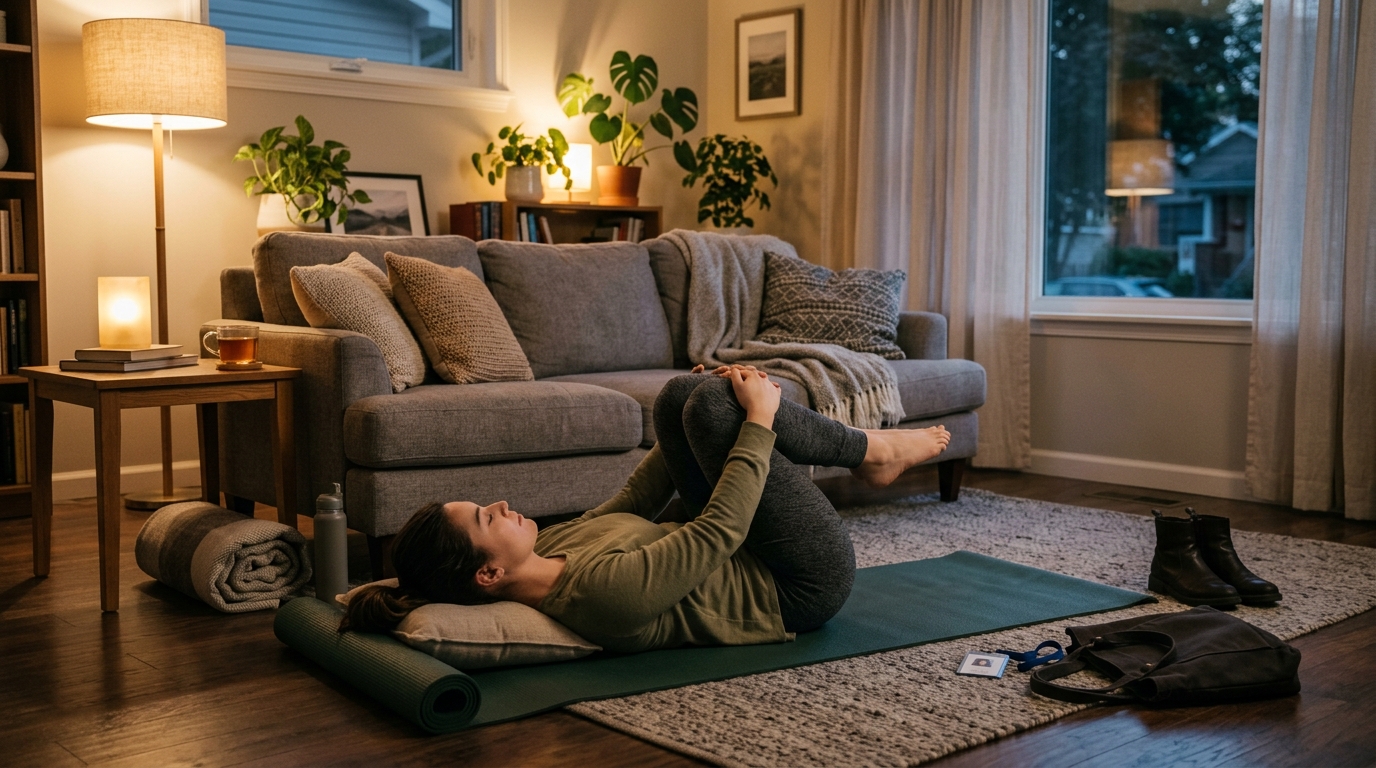
When Standing All Day Leaves Your Back and Pelvis Exhausted
If you work in a job where you stand most of the day—teaching, retail, healthcare, service work, or long hours in the lab—you probably know the feeling of coming home and wanting to collapse on the floor. Your feet burn, your lower back feels heavy and tight, and your hips and pelvis seem locked in place. Sometimes the stiffness even carries into the next morning.
Standing is not automatically bad, but standing in one position for hours can keep the muscles around your spine and pelvis in a constant low-level contraction. This 15-minute routine is designed as a gentle, after-work way to loosen your lower back and pelvis, improve circulation, and reduce everyday stiffness—not as a medical treatment for serious back or hip problems.
I tested this routine on evenings after long days of standing and walking around, and even one 15-minute block made my lower back feel lighter and made it easier to stand upright the next morning.
Important Safety Note Before You Start
This routine is for mild stiffness and everyday fatigue after long periods of standing, not for diagnosing or treating serious pain or disease. If your symptoms are severe, new, or persistent—such as sharp pain, strong numbness, weakness, or pain that travels down your leg—stop these exercises and consult a doctor or physical therapist before continuing.
During the stretches, you should feel gentle pulling or a pleasant stretch, never sharp, stabbing, or electric-like pain. If any movement makes your symptoms worse, reduce the range of motion or skip that exercise.
Why Long Periods of Standing Can Hurt Your Back and Pelvis
When you stand still for hours with your weight mostly on your legs, gravity continuously loads your feet, knees, hips, and spine. If you habitually lock your knees, lean into one hip, or bend slightly forward at the waist, certain muscles must work harder to keep you upright. Over time, this can lead to:
- Tightness around the lower back and pelvis
- Fatigue and soreness in your hips and legs
- A heavy, compressed feeling when you finally sit or lie down
Health guidance from many public organizations emphasizes that breaking up long periods of standing or sitting with short posture changes and gentle stretching can help reduce musculoskeletal strain, particularly in the lower back and hips. Even a few minutes of movement can give your spine and pelvis a chance to reset.
15-Minute Lower Back and Pelvis Reset After Standing All Day
This routine uses five movements:
- Pelvis and lower back release: 7 minutes
- Spine alignment and mobility: 5 minutes
- Gentle hamstring and hip release: 3 minutes
You can do these exercises on a yoga mat, a soft rug, or a firm bed. The most important rule is to stay within a comfortable range—aim for a refreshing stretch, not pain.
If you often alternate between long sitting and long standing, you may also find it helpful to use the 15-Minute Home Office Posture Reset: Gentle Stretches to Ease Back and Neck Tension on desk-heavy days and this standing recovery routine on your “on-your-feet” days.
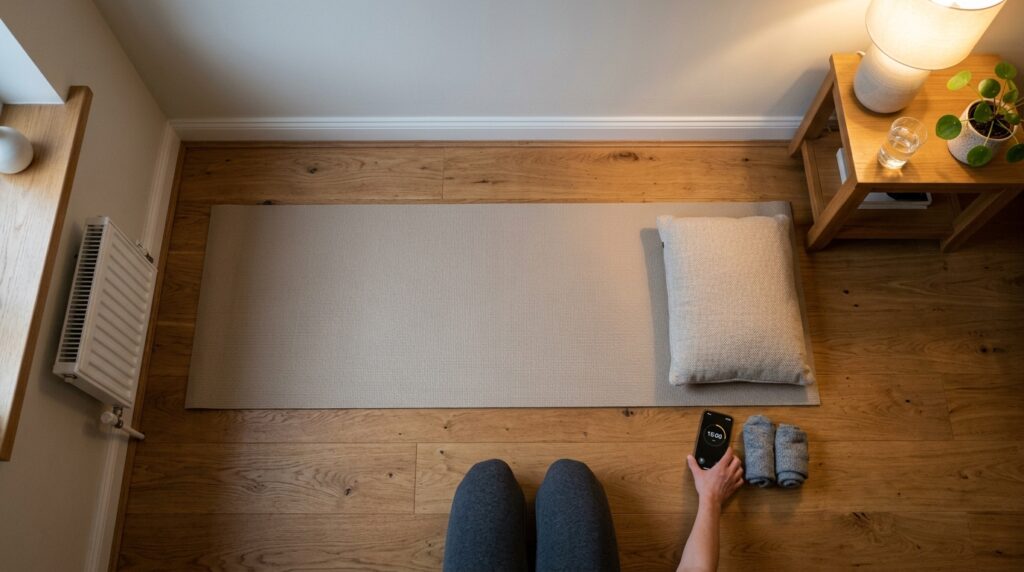
Step 1 – Pelvis and Lower Back Release (About 7 Minutes)
1. Knees-to-Chest Hug (1–2 Minutes)
- Lie on your back on a mat or firm bed, looking up at the ceiling.
- Slowly pull both knees toward your chest and wrap your arms around your shins or the backs of your thighs.
- Let your lower back sink comfortably toward the surface, as if you were gently pressing the space under your back down toward the mat.
- Breathe in through your nose and out through your mouth, feeling your belly soften as you exhale.
If your lower back feels very tight, do not pull your knees all the way in. Stop when you feel a gentle, comfortable stretch instead of sharp pulling.
2. Bridge Pose (2–3 Minutes)
- From lying on your back, place your feet flat on the floor about hip-width apart, heels approximately a hand’s length away from your hips.
- Rest your arms alongside your body.
- Inhale, then exhale as you slowly lift your hips and lower back away from the floor.
- Aim for a line from your shoulders through your hips to your knees, but only rise as high as feels comfortable.
- Hold for about 5 seconds, then exhale as you slowly roll your spine back down, one segment at a time, until your pelvis rests on the floor again.
Repeat 8–10 times. If your lower back hurts or feels unstable, lift your hips only a small amount and work in a smaller range at first.
Bridge pose gently activates the muscles around your pelvis and lower back, which can become tired and overloaded after supporting you all day.
3. Side-to-Side Spinal Twist (2–3 Minutes)
- Stay on your back with your knees bent and feet flat on the floor, legs together.
- Stretch your arms out to the sides in a T shape.
- Inhale, then exhale as you slowly lower both knees toward the right while turning your head to the left.
- You should feel a mild twist through the side of your waist, lower back, and hip—not a sharp or pinching sensation. Hold for 20–30 seconds.
- Return to the center and repeat to the other side.
Alternate left and right for 2–3 rounds. If you feel sharp, shooting, or electric-like pain in your back or legs, reduce the twisting angle and move only within a comfortable range.
Step 2 – Spine Alignment and Mobility (About 5 Minutes)

4. Cat–Cow (Cat–Cow Pose, 4–5 Minutes)
- Come onto your hands and knees on the mat. Place your hands under your shoulders and your knees under your hips.
- Spread your fingers and gently press your palms into the floor. Keep your neck long, looking toward the space between your hands.
Move with your breath:
- Cow pose (inhale): Let your belly drop slightly toward the floor, gently lift your chest forward, and look a bit ahead of you without crunching your neck.
- Cat pose (exhale): Draw your belly in and round your back toward the ceiling, tucking your chin slightly to look toward your navel.
Alternate between cow on the inhale and cat on the exhale for 8–10 slow rounds. Focus on moving smoothly from your pelvis through your mid-back, rather than forcing a big curve in your neck.
Simple spinal mobility exercises like cat–cow are often recommended in back-care programs to help maintain flexibility and reduce stiffness in the lower back, especially for people who spend long periods standing or sitting in one position.
Step 3 – Hamstring and Hip Release (About 3 Minutes)
5. Lying Hamstring Stretch (3 Minutes)
- Lie on your back again.
- Bend your right knee and place your foot flat on the floor.
- Lift your left leg and hold the back of your thigh with both hands, just above the knee.
- Gently straighten your left knee as much as is comfortable, pointing your heel toward the ceiling. It is perfectly fine if your knee stays slightly bent.
- Pull your toes lightly toward your face to feel a gentle stretch along the back of your thigh and calf. Hold for 20–30 seconds.
- Switch legs and repeat on the other side.
Alternate legs for 2–3 rounds per side. If the stretch feels too intense, keep the knee more bent and reduce the pull. The goal is to ease tension in the muscles that support your pelvis and knees after a long day on your feet.
What This 15-Minute Routine Can and Cannot Do
This routine focuses on gently moving and relaxing the muscles and joints around your pelvis, lower back, and hips after long periods of standing. With regular practice, you may notice:
- Less stiffness when you finally sit or lie down after standing all day
- A lighter feeling in your hips and lower back the next morning
- Easier, more comfortable upright posture at work
However, it is important to keep realistic expectations:
- This routine does not realign bones or replace medical treatment for serious spine or hip conditions.
- It is a light, at-home management routine meant to support better alignment and circulation by addressing muscular tightness and everyday posture habits.
If your pain is strong, keeps getting worse, or regularly travels into your buttock or leg, pause this routine and seek advice from an orthopedic or rehabilitation specialist.
Everyday Tips to Protect Your Back and Pelvis on Standing Days
You can combine this 15-minute routine with a few simple habits during your workday.
- Use short movement breaks: If possible, take a brief walk, gently bend and straighten your knees, or roll your ankles every 30–60 minutes instead of staying locked in one position.
- Shift your weight regularly: Rather than leaning into one hip, try to distribute your weight evenly between both legs and avoid locking your knees for long periods.
- Pair the routine with your evening schedule: Doing this sequence once before a shower or bedtime can help your muscles relax more fully and make your recovery sleep feel deeper.
If you have a job that also involves long periods of sitting—such as driving or computer work—you might like to rotate this routine with the 15-Minute Stretch Routine to Release Your Back and Hips After a Long Drive or the 15-Minute Neck, Shoulder, and Lower Back Stretch Routine for Keyboard and Mouse Users.
Related Routines You Might Like
- 15-Minute Pelvis and Lower Back Reset Routine at Home: Gentle Stretches for Everyday Stiffness – A similar routine focused on pelvic balance and lower back stiffness for mixed sitting and standing days.
- 15-Minute Back Stretch Routine for Desk Workers – A dedicated lower-back sequence for people who spend most of the day sitting.
- 15-Minute Recovery Stretch Routine for Your Back and Knees After Housework – A lower-body recovery routine for days when chores leave your back and legs tired.
Frequently Asked Questions
Q1. How often should I do this routine after standing all day?
If you stand for many hours on most workdays, aim to do this routine 3–5 evenings per week. On especially heavy days, even doing just Steps 1–3 for 5–10 minutes can help. The main goal is to build a consistent habit rather than to be perfect every day.
Q2. Can I do this routine before work, or only after work?
You can use it either way. Many people find it most helpful after work to release the tension that has built up, but a shortened version in the morning—such as the knees-to-chest hug, bridge pose, and cat–cow—can also prepare your back and pelvis for a long day on your feet.
Q3. Do I need a yoga mat or special equipment?
No. A yoga mat is helpful but not required. A firm bed, thick rug, or folded blanket on the floor is usually enough. The most important thing is that you have a comfortable, non-slippery surface where you can lie down and move safely.
Q4. What if my pain is sharp or goes down into my leg?
Sharp, burning, or electric-like pain, or pain that travels into your buttock or leg, can be a sign of more serious issues such as nerve irritation. In that case, stop the exercises and consult a healthcare professional before continuing. This routine is meant for mild stiffness and fatigue, not for treating severe or progressive pain.
Learn More
For more on posture, standing work, and musculoskeletal health, see:
- Mayo Clinic – Back Pain: Self-Care
Outlines safe self-care steps for mild back pain, including gentle stretching, posture changes, and advice on when to seek medical care.
https://www.mayoclinic.org/diseases-conditions/back-pain/in-depth/back-pain/art-20043992 - Mayo Clinic – Office Ergonomics: Your How-To Guide
Offers practical tips on adjusting your work setup—whether sitting or standing—to reduce strain on your neck, shoulders, and lower back.
https://www.mayoclinic.org/healthy-lifestyle/adult-health/in-depth/office-ergonomics/art-20046169 - CCOHS – Working in a Standing Position
Provides guidance on healthy standing posture, footwear, and the importance of taking breaks to prevent fatigue and musculoskeletal discomfort.
https://www.ccohs.ca/oshanswers/ergonomics/standing/standing_basic.html
Leave a Reply