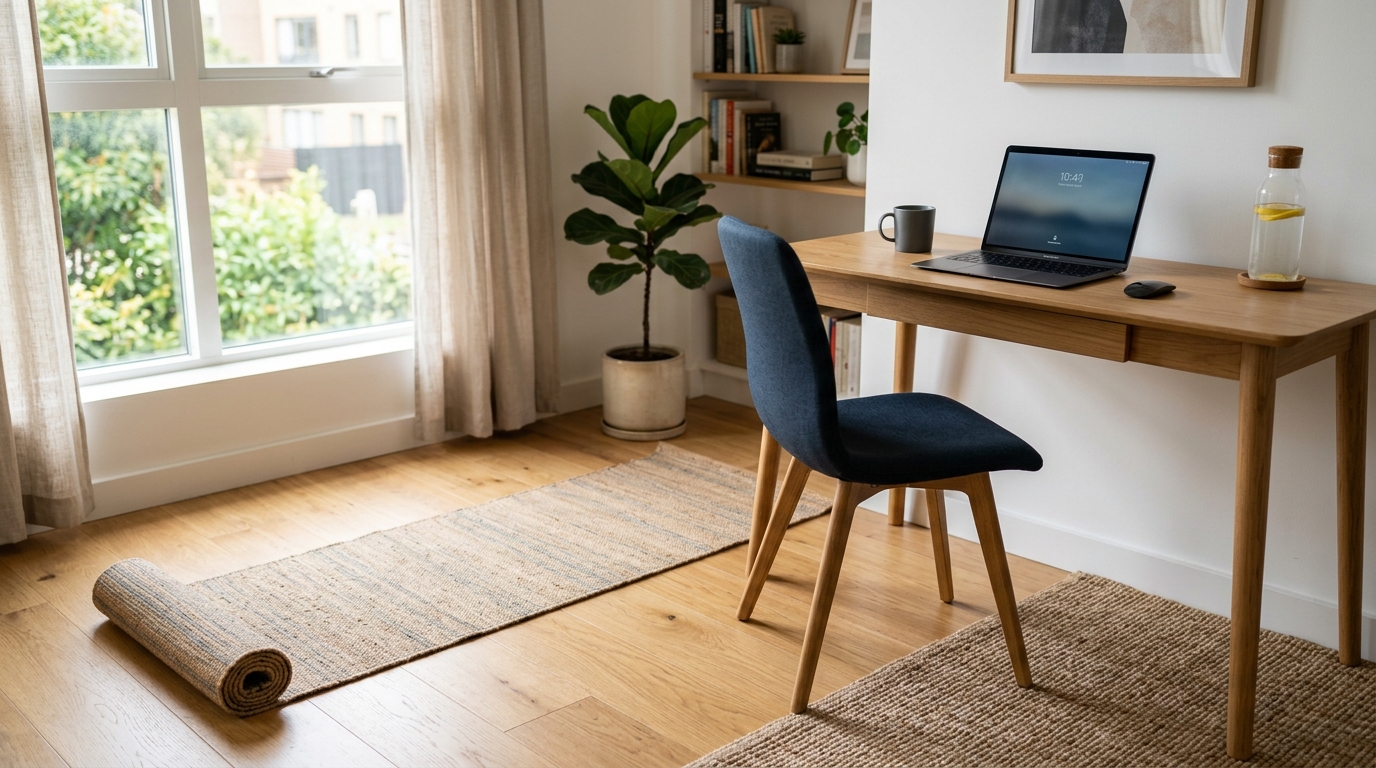
You stand up after hours at your desk and feel that familiar pull in your lower back, as if your hips and pelvis are stuck in “sitting mode.”
Your steps feel a bit stiff, your hips don’t swing naturally, and your body reminds you how long you’ve been in the chair.
This routine is for desk workers, remote workers, and anyone who spends most of the day sitting and feels tightness in the lower back and pelvis when they finally stand up.
We’ll walk through a gentle 15-minute pelvic correction stretching routine focused on your hip flexors, glutes, and hamstrings, so your lower back doesn’t have to do all the work on its own.
This routine is for mild stiffness and everyday fatigue, not for treating serious pain or disease. If symptoms are severe, new, or persistent, consult a healthcare professional before continuing.
I tested this routine on days when my lower back felt tight after long writing sessions, and one 15-minute block was enough to make walking and standing feel noticeably easier.
Why Your Pelvis Feels “Stuck” After Sitting
When you sit for long periods, your hip flexors at the front of your hips stay in a shortened position.
Over time, this can make the front of your hips feel stiff, your glutes switch off, and your lower back compensate for the lack of hip movement.
Many people describe this as “my pelvis feels twisted” or “my hips feel off,” but often it’s more about tight hip muscles and poor coordination than bones being out of place.
The goal of this routine is not to “crack things back into place,” but to gently restore mobility and coordination around your hips and lower back.
Overview: The 15-Minute Pelvic Reset Routine
This routine is broken into three simple phases:
- Phase 1 – Front of the hips (4 minutes)
- Phase 2 – Glutes and hamstrings (7 minutes)
- Phase 3 – Pelvis–lower back connection (4 minutes)
You don’t need any equipment, just a mat or a comfortable surface.
If you want a full-body option for days when your whole back feels stiff, you might also like our 15-Minute Back Stretch Routine for Desk Workers.
Phase 1 – Release the Front of Your Hips (4 Minutes)
When you sit all day, your hip flexors become short and tight. This first step aims to gently open them up.

Half-kneeling hip flexor stretch
- Start in a half-kneeling position with one knee on the floor and the other foot in front, knee stacked over ankle.
- Gently tuck your pelvis under, as if drawing your belly button slightly toward your spine.
- Lean your weight forward just enough to feel a stretch at the front of the hip on the kneeling side.
- Hold for 20 seconds, breathing slowly.
- Switch sides and repeat. Do 2 rounds per side.
Key cues:
- Think “lift and tuck” with your pelvis, not “arch your lower back.”
- The stretch should feel like a firm pull in the front of the hip, not sharp pain.
If you’re interested in more ways to reset your posture after sitting, check out 15-Minute Home Office Posture Reset: Gentle Stretches to Ease Back and Neck Tension.
Phase 2 – Glutes and Hamstrings Release (7 Minutes)
Next, you’ll release the back of your hips and thighs, which often pick up extra tension when your pelvis and hip flexors are tight.
Seated figure-four glute stretch
- Sit on the floor with both legs in front of you.
- Cross your right ankle over your left knee, forming a figure-four shape.
- Gently lean your torso forward until you feel a stretch deep in your right glute.
- Hold for 20–30 seconds, breathing steadily.
- Switch sides and repeat. Do 2 rounds per side.
Hamstring hinge stretch
- Sit with one leg straight in front of you and the other leg bent comfortably.
- Place your hands on your straight leg or on the floor beside it.
- Hinge forward from your hips, keeping your back long rather than rounding.
- Stop when you feel the back of your thigh lengthen, and hold for 20–30 seconds.
- Switch legs and repeat. Do 1–2 rounds per side.
Think of this phase as making space in the back of your hips and thighs so your lower back doesn’t have to stretch and strain alone when you stand up.
Phase 3 – Connect Your Pelvis and Lower Back (4 Minutes)
Now that the front and back of your hips are more open, you’ll gently coordinate your pelvis and lower back.
Rocking knees-to-chest
- Lie on your back with your knees bent.
- Gently hug both knees toward your chest.
- Slowly rock side to side in a small range, letting your lower back and pelvis roll together.
- Continue for about 1 minute, breathing naturally.
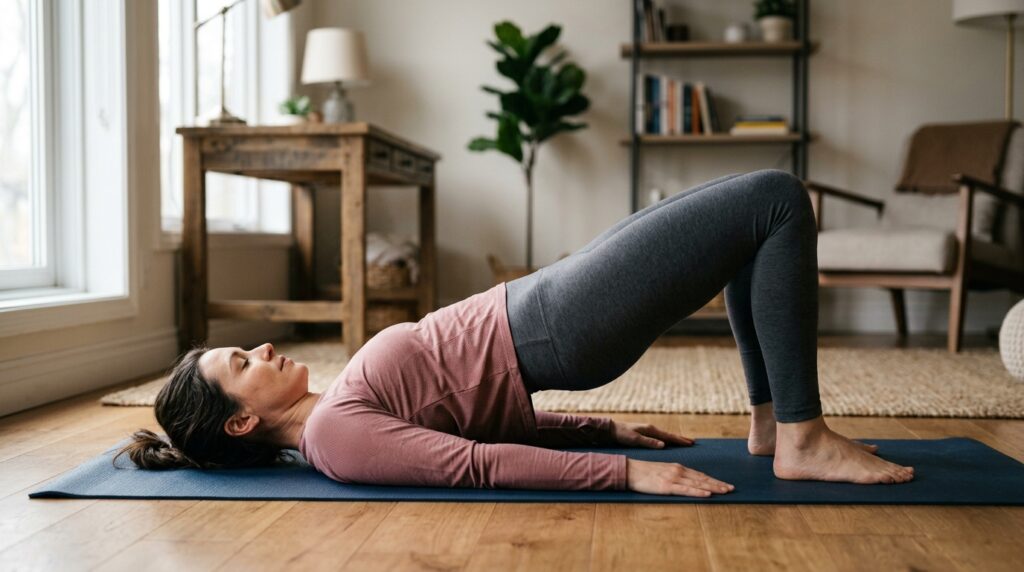
Gentle bridge lifts
- Lie on your back with your knees bent and feet hip-width apart.
- Press your feet into the floor and gently squeeze your glutes.
- Lift your pelvis off the floor just until your body forms a straight line from shoulders to knees.
- Hold for 2–3 seconds, then slowly lower back down.
- Repeat 8–10 times.
Focus on moving smoothly and controlling the lowering phase. The goal is to help your hips and lower back share the work, not to push for a big arch.
For more on using gentle bridge work and mobility exercises to reset your posture after long days, see 15-Minute Posture Reset Routine After a Day of Sitting, Standing, and Driving.
When to Use This 15-Minute Pelvic Reset
The best times to use this routine are:
- Right after work, before you settle into the couch for the evening
- Before bed, if your lower back feels tight from sitting
- Before long periods of sitting (like a long meeting or drive), as a pre-emptive reset
You can do this routine 3–5 times per week. If it feels good and your body responds well, daily use is fine—as long as you stay within a comfortable stretch range.
If you want a paired routine that targets your lower back and pelvis together, you may also like 15-Minute Pelvis and Lower Back Reset Routine at Home.
Related Routines You Might Like
- 15-Minute Pelvis and Lower Back Reset Routine at Home: Gentle Stretches for Everyday Stiffness – A full routine focused on daily pelvic and lower back stiffness.
- 15-Minute Stretch Routine to Ease Lower Back and Pelvis Tension After Standing All Day – Designed for people who stand all day instead of sitting.
- 15-Minute Stretch Routine to Release Your Back and Hips After a Long Drive – Perfect after long commutes or road trips.
Frequently Asked Questions
Q1. How often should I do this pelvic correction stretching routine?
Aim for 3–5 times per week, especially on days when you sit for several hours.
If your body responds well and the stretches feel good, you can safely do this daily, as long as you stay within a mild to moderate stretch and avoid pain.
Q2. Can I do this routine at the office?
Yes. You can do most of these stretches on a mat in a quiet room, or even at home right after work.
If you don’t have space at the office, consider doing Phase 1 and Phase 2 at home as a post-work reset.
Q3. What if my lower back hurts during the stretches?
You should feel a stretch or gentle release, not sharp pain.
If any movement increases your pain, skip that exercise and consider consulting a physical therapist or healthcare professional to get personalized guidance.
Q4. Is this routine enough if I already have diagnosed low back problems?
This routine is designed for everyday stiffness, not for treating diagnosed conditions like disc herniation or spinal stenosis.
If you have a known back condition, check with your doctor or physical therapist before adding new stretching routines.
Learn More
For more on hip mobility, low back health, and sitting-related pain, see:
- NBC Better – Sit all day? Try these desk stretches to loosen your hips
Practical hip and glute stretches you can do during the day to counteract tight hips from sitting.
https://www.nbcnews.com/better/lifestyle/sit-all-day-try-these-desk-stretches-loosen-your-hips-ncna1006566 - Hospital for Special Surgery – Four Hip Flexor Stretches to Relieve Tightness, from a PT
A physical therapist’s guide to safe, effective hip flexor stretches for people who spend a lot of time sitting.
https://www.hss.edu/health-library/move-better/hip-flexor-stretch - One Institute – The 5 Best Mobility Exercises for Desk Workers: Preventing Aches and Pains
Shows simple hip, spine, and shoulder mobility exercises specifically for desk workers, including a hip flexor stretch to counter tight hips from sitting.
https://oneinstitute.nl/the-5-best-mobility-exercises-for-desk-workers-preventing-aches-and-pains/
Leave a Reply